Author: Dr. Richard Zeng, Acupuncturist Melbourne, TCM Doctor
Quick Navigation
When patients ask me about “seed cycling” for fertility, I smile a little – not because it’s a new idea, but because it’s a very old one. Traditional Chinese Medicine has had its own seed-based fertility formula for close to a thousand years. It’s even named after seeds: Wu Zi Yan Zong Wan (五子衍宗丸, wǔ zǐ yǎn zōng wán), which translates roughly to “Five Seeds Pill to Bring Forth Offspring.”
I find it genuinely interesting when two very different medical traditions – one built on centuries of clinical observation, the other on modern nutritional biochemistry – arrive at a similar idea from opposite directions. In this post, I want to walk through both:
- what the TCM formula does, what the seed cycling approach involves,
- what current research actually shows, and
- where I think the two traditions can support each other in a fertility care plan.
As always, this is general information, not a substitute for individualised clinical advice. Fertility is influenced by many factors, and any herbal or nutritional approach should be discussed with your practitioner alongside your existing fertility care.
Wu Zi Yan Zong Wan: TCM’s Original “Seed” Formula
Wu Zi Yan Zong Wan was developed during the Ming dynasty and is built around a simple but elegant TCM principle:
以子补子 (yǐ zǐ bǔ zǐ), “using seeds to supplement seeds.”
In TCM theory, plant seeds carry a concentrated form of the plant’s reproductive vitality, and this formula uses five of them to nourish what we call Kidney Jing (肾精, shèn jīng) – Kidney Essence, the substance TCM considers foundational to reproduction, growth, and development.
The five seeds are:
- Gou Qi Zi (枸杞子) – goji berry, the lead herb for nourishing Kidney and Liver essence
- Tu Si Zi (菟丝子) – dodder seed, warming and Yang-tonifying for the Kidneys
- Fu Pen Zi (覆盆子) – Chinese raspberry fruit, which helps consolidate and “lock in” the essence
- Che Qian Zi (车前子) – plantain seed, which keeps the formula moving rather than stagnant
- Wu Wei Zi (五味子) – schisandra berry, an astringent that also supports the consolidation action
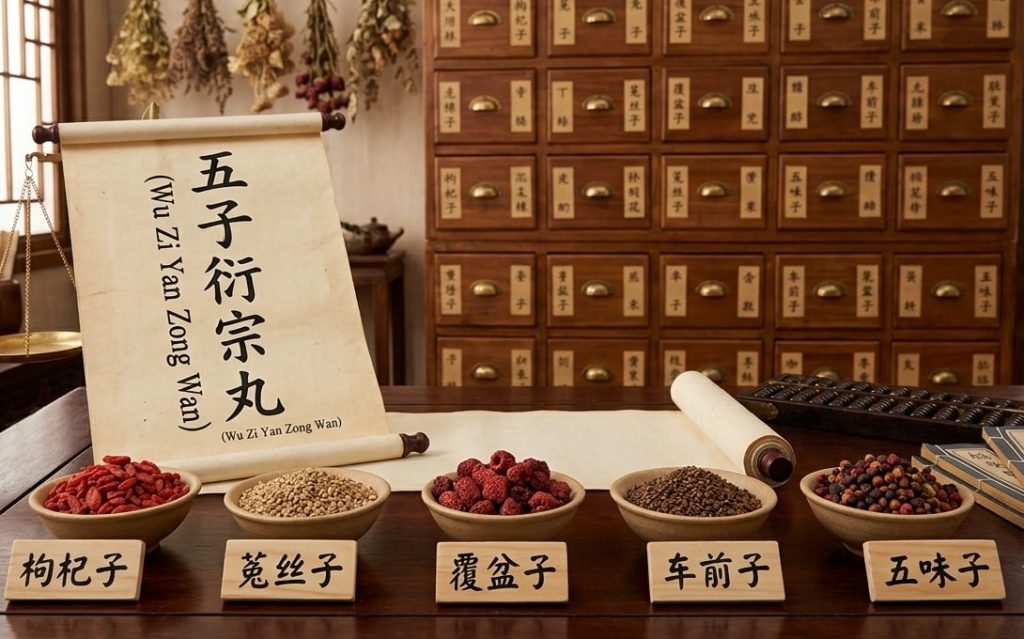
Wu Zi Yan Zong Wan – Five Seed Formula for Fertility Health
Together, this combination is traditionally used for what TCM describes as Kidney Qi, Yang, and Jing deficiency patterns – presentations that often overlap with low sperm count, poor sperm motility, and general reproductive fatigue in men, though the formula has historically been used to support fertility more broadly.
What the research says
Modern research on Wu Zi Yan Zong Wan has focused mainly on male fertility, and the results are worth paying attention to.
A 2025 meta-analysis pooling 11 randomised controlled trials and 951 men found that adding the formula to standard treatment was associated with meaningfully higher pregnancy rates in female partners, along with improvements in semen volume, sperm concentration, and both total and forward sperm motility, plus reductions in abnormal sperm morphology.
A separate double-blind, placebo-controlled trial in Hong Kong involving men with low motile sperm counts also reported improvements in semen quality and sperm function, with a higher two-year pregnancy rate among men who took the formula.
Animal and laboratory studies have tried to explain why. Research has suggested the formula may support semen quality in men with poor semen parameters or unexplained infertility, and may reduce sperm DNA damage in men with low sperm counts, while mechanistic studies point to effects on oxidative stress and cell survival pathways within the testes.
It’s worth being clear-eyed here: the meta-analysis authors themselves note that larger, well-designed trials are still needed. This is promising evidence for an adjuvant approach, not a proven stand-alone treatment — which is exactly why I prescribe it as part of a broader plan rather than in isolation.
Seed Cycling: The Western Nutritional Take
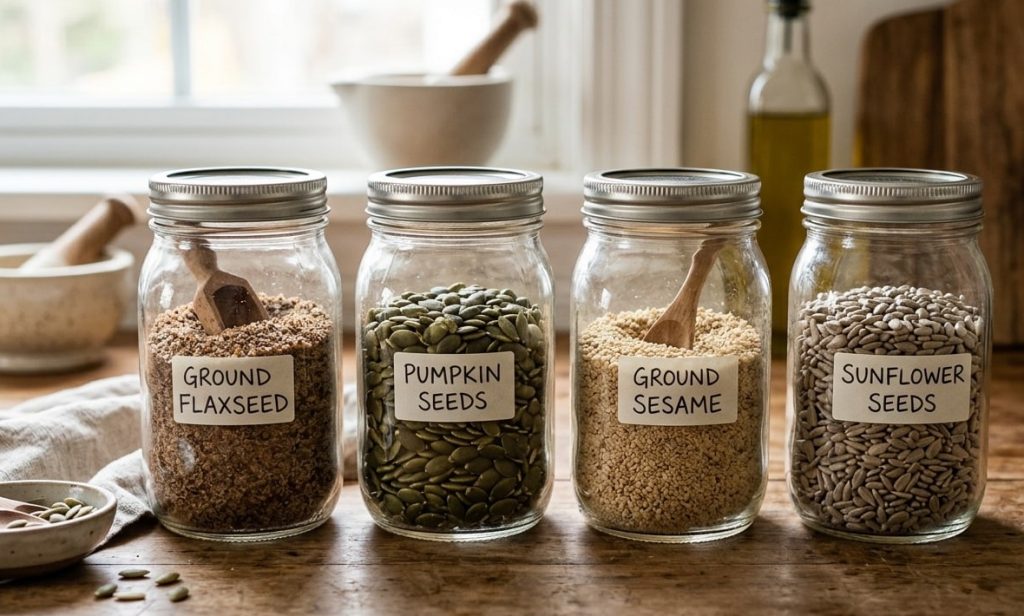
On the other side of the world, a newer nutritional practice called “seed cycling” has been gaining attention for women’s hormonal and fertility support – including at dedicated seed-cycling businesses here in Australia. The idea is to eat different seeds across the two halves of the menstrual cycle:
- Follicular phase (roughly days 1-14): ground flaxseed and pumpkin seeds
- Luteal phase (roughly days 15-28): ground sesame seeds and sunflower seeds
The proposed mechanisms are nutritional rather than energetic.
- Flaxseed and sesame seed are rich in lignans, plant compounds that can act as mild phytoestrogens and may help modulate how the body metabolises estrogen.
- Pumpkin seed and sesame seed are good sources of zinc, a mineral involved in progesterone production, while sunflower seed provides vitamin E and selenium, which are linked to antioxidant support and healthy thyroid function – itself closely tied to reproductive hormone regulation.
So the honest picture is this: the individual nutritional components – lignans, zinc, selenium, vitamin E – have reasonably good evidence behind their roles in hormone metabolism.
Where the Two Traditions Meet
What I find most useful clinically isn’t choosing one system over the other – it’s noticing where they agree. Both traditions independently identified seeds as a concentrated source of reproductive support, and both point toward the same underlying nutrients doing meaningful work: zinc for hormone production, antioxidants for protecting egg and sperm quality, and lignans or phytochemicals for hormone metabolism.
In practice, this means:
- For men, Wu Zi Yan Zong Wan (adjusted to the individual’s pattern) may be considered alongside lifestyle changes as part of a fertility support plan, particularly where semen parameters are a concern.
- For women, incorporating flax, pumpkin, sesame, and sunflower seeds through the diet – whether cycled with the menstrual phases or simply eaten regularly – is a low-risk way to add zinc, selenium, vitamin E, and lignans to support hormonal health.
- For couples, thinking about fertility as something both partners can nutritionally and herbally support tends to produce better outcomes than focusing on one partner alone.
None of this replaces a proper fertility work-up, and herbal formulas like Wu Zi Yan Zong Wan should be tailored to your individual TCM pattern rather than taken generically – the raw formula isn’t right for every presentation, and interactions with other medications or supplements should always be checked with your practitioner first.
A Note on Expectations
I want to be upfront: neither seeds nor herbal formulas are a guaranteed fix for fertility challenges, and the research, while encouraging, is still developing in both traditions. What both bodies of evidence support is that seeds – as a category – may play a meaningful supportive role in reproductive hormone health and semen quality, alongside good sleep, stress management, and any medical fertility treatment you’re already pursuing.
If you’d like to talk through whether Wu Zi Yan Zong Wan or a tailored seed-based nutrition plan makes sense for your situation, our practitioners at Almond Wellness Centre are happy to assess your individual pattern and put together a fertility preparation plan that fits alongside your existing care.
References
- Cui F, Zhang Y, Fan Y. Adjuvant treatment with Wu-Zi-Yan-Zong formula for abnormal sperm parameters associated with male infertility: a meta-analysis of randomized controlled trials. Front Pharmacol. 2025;16:1580705. doi:10.3389/fphar.2025.1580705.
- Zhao MP, Shi X, Kong GWS, Wang CC, Wu JCY, Lin ZX, et al. The therapeutic effects of a traditional Chinese medicine formula Wuzi Yanzong Pill for the treatment of oligoasthenozoospermia: a meta-analysis of randomized controlled trials. Evid Based Complement Alternat Med. 2018;2018:2968025. doi:10.1155/2018/2968025.