Almost every week, a patient asks me some version of the same question:
“I’ve had dry needling before at my physio. Isn’t that basically acupuncture?”
It’s a fair question. Before 2012, though, I almost never heard it. Most people simply hadn’t encountered the term “dry needling” yet.
That changed as Australia’s health regulation changed. The history explains the question – and why the honest answer to acupuncture vs dry needling is more nuanced than a simple yes or no.

How Australia Got Here
- Before 2002, acupuncture sat in a regulatory grey zone. Practitioners from various backgrounds used the needle for musculoskeletal complaints, often under names like “musculoskeletal acupuncture” or “trigger point acupuncture.” “Dry needling” wasn’t yet part of everyday conversation.
- In 2002, Victoria became the first state to regulate the profession, under the Chinese Medicine Registration Act 2000. The goal: protect the public through minimum standards of acupuncture training, competence and accountability.
- In 2012, the National Registration and Accreditation Scheme (NRAS) brought acupuncturists under the Chinese Medicine Board of Australia (CMBA) and AHPRA registration nationally. Protected titles now included acupuncturist, Chinese medicine practitioner and Chinese herbal medicine practitioner.
Here’s the part patients most often misunderstand: the law protects professional titles, not the act of inserting a needle. The CMBA has stated publicly that “dry needling” is not a protected title, and that using it isn’t an offence. As the Board has put it, its role isn’t to shield the acupuncture profession from competition.
Dry needling is not a regulated health profession or protected practice in Australia. It is commonly performed by physiotherapists, chiropractors and osteopaths as part of their registered profession, but may also legally be offered by practitioners who are not registered under AHPRA, such as some myotherapists or massage therapists – as long as they don’t call it “acupuncture” or use a protected title.
Why did the term catch on when it did?
Its widespread use appeared during the same period that “acupuncturist” became a protected title. Janz and Adams examined this directly in a 2011 paper, tracing the label’s rise alongside regulatory change rather than any new needling technique. This isn’t a claim about anyone’s motives — different professions genuinely use different frameworks – but the timing is well documented, and it’s the clearest explanation for why this question barely existed twenty years ago and comes up daily now.
Why Both Treatments Use the Same Needle
This is usually the first thing that confuses patients.
Both professions generally use a solid filiform needle – thin, flexible, sterile and single-use, manufactured to standardised specifications. It’s very different from the hollow needles used for injections.
Because both use essentially the same tool, Australian law doesn’t try to regulate the needle. It regulates who is qualified to call themselves what. That’s the real distinction – and why two different treatments can look identical from the patient’s chair.
Where They Really Differ
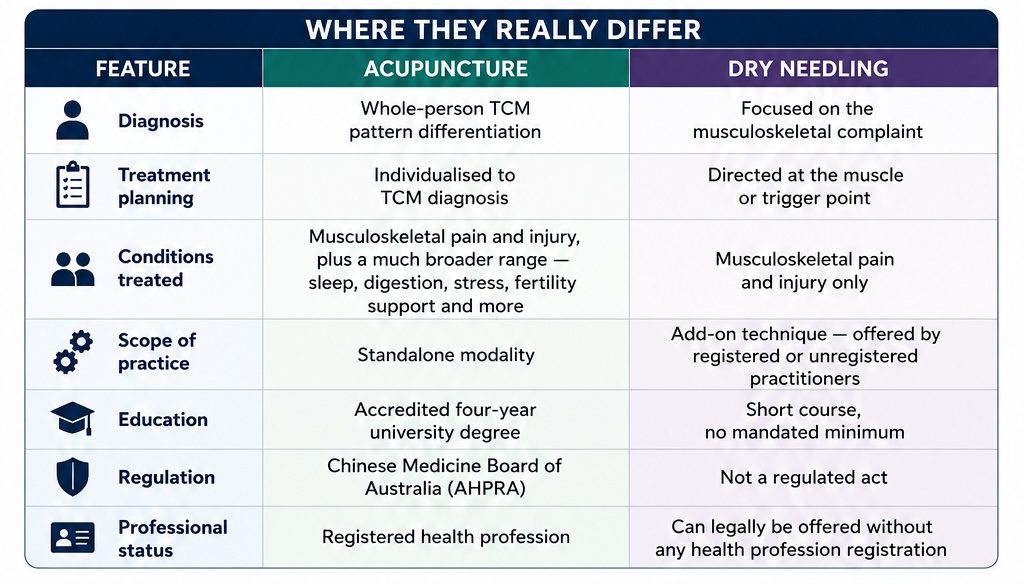
A registered acupuncturist is trained to weigh a patient’s broader pattern – sleep, digestion, stress, tongue and pulse – alongside the local pain. Dry needling, as generally taught, focuses more narrowly on the muscle itself.
It’s also worth being clear about scope. Acupuncture can address musculoskeletal pain and injury in the same way dry needling does – needling muscles and tendons to relieve tension and pain is a routine part of acupuncture practice. But acupuncture isn’t limited to this. It’s also used for a much wider range of conditions, from sleep and digestive complaints to stress and fertility support. Dry needling, by contrast, is generally applied only to musculoskeletal pain and injury.
Training Matters More Than Terminology
Because dry needling isn’t a regulated act, it doesn’t require any health profession registration. It’s commonly taught as an add-on skill to physiotherapists, chiropractors and osteopaths – but it can equally be offered by myotherapists, massage therapists or other unregistered “therapists,” without breaching any law.
Course length varies enormously, from a single weekend to far more extensive supervised training, with no consistent minimum standard across providers.
In practice, the term “dry needling” alone tells you very little – not just about how much training someone has, but whether they hold any health profession registration. Two practitioners may both advertise “dry needling,” yet one may have completed years of university education in needling while another has undertaken only a short postgraduate course. The term itself doesn’t tell patients which applies. That’s not a criticism of any individual. It’s simply a reason to ask.
On safety:
inserting a needle through the skin carries recognised risks – bruising, minor bleeding, and rarely, infection or nerve injury. Published research suggests most adverse events are mild and temporary. Serious complications, including pneumothorax (a collapsed lung) from needling near the chest wall, have been reported, though uncommonly.
What lowers these risks isn’t the treatment’s name – it’s the practitioner’s anatomical knowledge, clinical judgement and infection control. Because dry needling can legally be offered without registration, that training can’t be assumed. It needs to be asked about. Informed consent includes understanding who is performing the procedure, what training they have received, what risks are involved and what alternatives are available.
Why Training Matters
Before treatment, don’t hesitate to ask:
✓ Are you registered with AHPRA?
✓ What training have you completed in needling?
✓ How much supervised clinical experience have you had?
✓ How often do you treat this condition? ✓ What are the possible risks?
Patients deserve clear answers before consenting to any procedure involving needles.
Why Medicare Covers One But Not the Other
Another common question: if a physio can bill Medicare for a session that includes dry needling, why can’t I claim Medicare for acupuncture with a registered acupuncturist?
It comes down to how Medicare funds allied health, not the needling itself. Registered acupuncturists are currently excluded from Medicare’s Chronic Disease Management allied health pathway. Physiotherapists, chiropractors and several other allied health professions can bill under that scheme – so when dry needling is part of a physio session, Medicare funds the physiotherapy consultation, not the needling.
A small number of doctors with recognised acupuncture training can bill Medicare acupuncture items, tied to a medical consultation. For most patients seeing a registered acupuncturist, private health insurance extras – not Medicare – is the relevant pathway. Our reception team can help you check your cover before your first visit.
What Should You Ask Your Practitioner?
Whichever practitioner you see – registered acupuncturist, physiotherapist, chiropractor, osteopath, or an unregistered therapist offering dry needling – it’s reasonable to ask:
- What formal education have you completed in needling?
- How much supervised clinical training did that involve?
- Are you registered with AHPRA, and under which board?
- What experience do you have treating my specific condition?
- What risks should I know about before we start?
You’re entitled to clear answers before consenting to treatment.
Conclusion
The resemblance largely ends with the instrument itself. Behind the needle sits a different diagnostic model, a different depth of education, and a different regulatory framework – one shaped largely by Australia’s move to national practitioner registration in 2012, and one where the term “dry needling” itself is not separately regulated or protected under Australian law.
Rather than focusing on what the treatment is called, patients are better served by asking about the practitioner’s education, clinical experience, registration and approach to diagnosis. Those answers are far more meaningful than the label on the treatment.
Frequently Asked Questions
Is dry needling a registered profession in Australia?
No. It isn’t a regulated act. Physiotherapists, chiropractors and osteopaths commonly offer it, but so can unregistered practitioners, such as myotherapists or massage therapists — as long as they don’t use protected titles like “acupuncturist.”
Is dry needling the same as acupuncture?
Both generally use the same needle, but they differ in diagnostic framework, training, regulation and scope. Acupuncture is a standalone, university-trained profession grounded in TCM diagnosis, and it treats musculoskeletal pain and injury as well as a much broader range of conditions. Dry needling is a shorter, add-on technique grounded in Western musculoskeletal theory, generally limited to musculoskeletal pain and injury.
Why did the term “dry needling” become common after 2012?
Its widespread use closely followed national registration for acupuncture under AHPRA, when “acupuncturist” became a protected title.
Can I check whether my acupuncturist is registered?
Yes. Anyone using the title “acupuncturist” must be registered with the Chinese Medicine Board of Australia – verifiable on AHPRA’s public register.
Does Medicare cover acupuncture at Almond Wellness Centre?
Medicare doesn’t currently rebate acupuncture by registered acupuncturists. Many private health extras policies do cover it – our reception team can help you check before your first appointment. If you’re searching for acupuncture Melbourne clinics that can explain your rebate options, our team is happy to help.
References
- Janz S, Adams J. Acupuncture by another name: Dry needling in Australia. Australas J Acupunct Chin Med. 2011;6(2):3–6.
- Chinese Medicine Board of Australia. FAQ: Dry Needling and Acupuncture. Available from: https://www.chinesemedicineboard.gov.au
- Chinese Medicine Board of Australia. Communiqués and stakeholder forum statements regarding dry needling. Available from: https://www.chinesemedicineboard.gov.au
- Health Practitioner Regulation National Law Act (as in force in each Australian state and territory), Section 113 (Protected Titles).
- Australian Health Practitioner Regulation Agency (AHPRA). Chinese Medicine Board of Australia Registration Standards. Available from: https://www.ahpra.gov.au
- Medicare Benefits Schedule. Acupuncture Services (Items 193–197). Australian Government Department of Health. https://www.mbsonline.gov.au
- Medical Services Advisory Committee (MSAC). Applications relating to acupuncture and allied health services. Australian Government.