By Dr Richard Zeng, Registered Chinese Medicine Practitioner
Many women are told that painful periods are simply part of being female.
If you’ve ever had to curl up with a heat pack, cancel plans, miss work, or rely on painkillers every month just to get through your period, you know that period pain can have a major impact on your life.
Over the years, I have treated many women with:
- Endometriosis
- Painful periods (dysmenorrhoea)
- Adenomyosis
- Fibroids
- Chronic pelvic pain
- Pelvic inflammatory conditions
One of the Chinese herbal formulas I commonly use for these conditions is what I call 痛经汤 (Tòng Jīng Tāng) – the Period Pain Formula.
While every prescription is individualised, this formula forms the basis of treatment for many women whose pain is associated with what Traditional Chinese Medicine (TCM) calls Blood Stasis (血瘀).
Why Does Period Pain Occur?
In Chinese medicine, there is a simple principle:
不通则痛 – “Where there is blockage, there is pain.”
When the circulation of Qi and Blood becomes restricted within the uterus and pelvis, pain develops.
Common signs of Blood Stasis include:
- Severe cramping
- Stabbing or fixed pain
- Pain before or during menstruation
- Dark menstrual blood
- Blood clots
- Lower abdominal tenderness
- Endometriosis
- Fibroids
- Chronic pelvic inflammation
Many women with endometriosis fit this pattern remarkably well.
However, Blood Stasis is often only part of the picture. In clinical practice, I frequently see other contributing factors such as:
- Cold in the uterus
- Stress and Liver Qi stagnation
- Kidney deficiency
- Chronic inflammation
- Hormonal imbalance
This is why Chinese herbal medicine focuses on treating both the symptoms and the underlying pattern.
The Period Pain Formula (痛经汤)
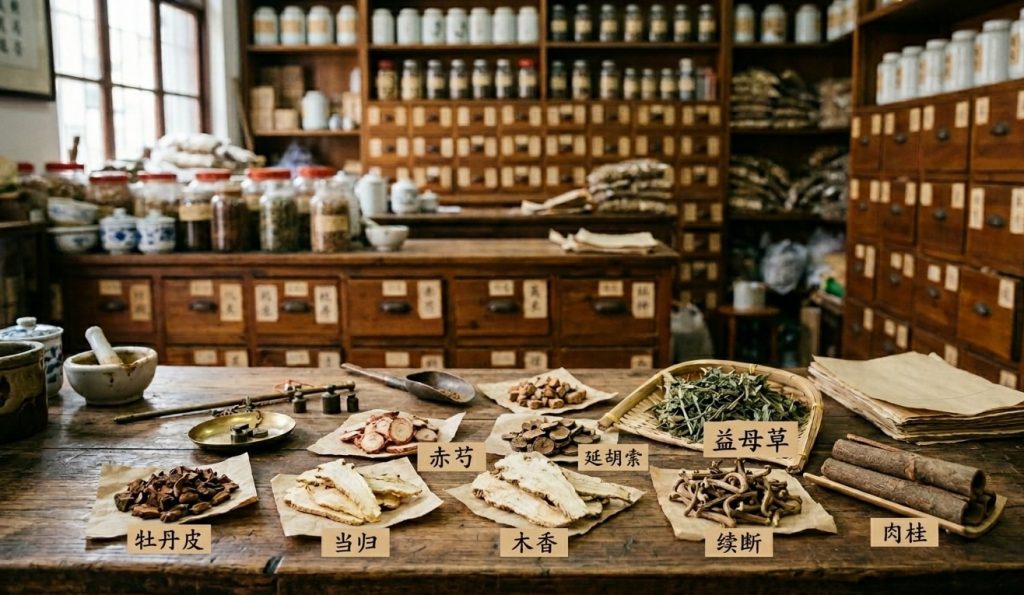
A typical prescription may include:
- Mu Dan Pi (牡丹皮) 10g
- Dang Gui (当归) 10g
- Chi Shao (赤芍) 10g
- Mu Xiang (木香) 10g
- Yan Hu Suo (延胡索) 12g
- Xu Duan (续断) 10g
- Du Zhong (杜仲) 10g
- E Zhu (莪术) 10g
- Yi Mu Cao (益母草) 15–30g
- Rou Gui (肉桂) 6g
- Gou Teng (钩藤) 12g (added during the final 10 minutes of cooking)
The treatment goals are to:
✔ Improve pelvic circulation
✔ Move Blood and resolve stasis
✔ Reduce pain and cramping
✔ Warm the uterus
✔ Support the Liver and Kidneys
✔ Improve long-term menstrual health
Four Important Herbs in This Formula
Yan Hu Suo (延胡索) – One of Chinese Medicine’s Best Herbs for Pain
Yan Hu Suo is one of my favourite herbs for menstrual pain.
It moves both Qi and Blood and is traditionally used for many types of pain, including:
- Period pain
- Pelvic pain
- Abdominal pain
- Musculoskeletal pain
Many patients notice improvements in pain intensity after this herb is introduced into their prescription.
E Zhu (莪术) – Breaking Up Long-Standing Stagnation
E Zhu is particularly useful when there is significant Blood Stasis.
I often consider it in patients with:
- Endometriosis
- Fibroids
- Chronic pelvic inflammation
- Long-standing pelvic pain
Its role is to help break through stubborn stagnation that has accumulated over time.
Yi Mu Cao (益母草) – The Traditional Women’s Herb
The name Yi Mu Cao literally means “benefit the mother herb.”
For centuries it has been used in Chinese medicine to:
- Regulate menstruation
- Improve circulation
- Reduce stagnation
- Support reproductive health
It remains one of the most frequently prescribed herbs in women’s health.
Rou Gui (肉桂) – Warming the Uterus
Many women notice their pain improves with a hot water bottle or heat pack.
This often suggests the presence of Cold in the uterus.
Rou Gui helps warm the channels, improve circulation, and reduce cold-related pain.
When I Modify the Formula
Chinese herbal medicine is never a one-size-fits-all treatment.
For example, some women with period pain also experience:
- Loose stools
- Digestive sensitivity
- IBS-type symptoms
- Bloating
In these cases I often modify the formula by:
Removing: Dang Gui
Adding:
- Dan Shen (丹参)
- Shen Qu (神曲)
- Fu Ling (茯苓)
This allows us to continue treating Blood Stasis while supporting digestion.
Case Study: Endometriosis and Severe Period Pain
A woman in her early 30s came to the clinic after being diagnosed with endometriosis.
Her symptoms included:
- Severe cramping every cycle
- Lower back pain
- Pain radiating into the thighs
- Dark menstrual blood with clots
- Dependence on pain medication
She received acupuncture and a modified version of the Period Pain Formula.
After several cycles:
- Pain intensity reduced significantly
- Clotting became less pronounced
- Lower back pain improved
- She required fewer painkillers
- She was able to continue her normal activities during menstruation
Most importantly, she felt she had regained control over her life during her period.
Case Study: Fibroids and Perimenopausal Pelvic Pain
A 47-year-old teacher presented with:
- Pelvic pressure
- Heavy periods
- Fibroids
- Lower abdominal pain
- Loose stools
A modified version of the formula was prescribed alongside acupuncture.
Over the following months she reported:
- Reduced pelvic discomfort
- Less clotting
- Improved bowel function
- More manageable periods
Her symptoms stabilised and her quality of life improved considerably.
What Does Research Say?
Research suggests that Chinese herbal medicine may help reduce period pain and improve quality of life in women with dysmenorrhoea. Several systematic reviews have reported encouraging results, although further high-quality studies are still needed.
This reflects what many practitioners observe clinically: when treatment is properly individualised, herbal medicine can be a valuable part of an integrated approach to women’s health.
Conditions This Formula May Be Considered For
Depending on the individual diagnosis, this formula may be modified and used for:
- Endometriosis
- Period pain
- Chronic pelvic inflammatory conditions
- Fibroids associated with Blood Stasis
- Pelvic congestion
- Perimenopausal abdominal pain
However, it is not suitable for every type of menstrual pain.
Different patterns require different treatments.
The Importance of Individual Assessment
One of the most common misconceptions about Chinese herbal medicine is that there is a single formula for every condition.
In reality, two women with endometriosis may receive completely different prescriptions based on their:
- Menstrual history
- Digestive health
- Sleep
- Energy levels
- Tongue and pulse findings
- Overall constitutional pattern
This is why professional assessment is essential before taking herbal medicine.
Looking for Natural Support for Endometriosis or Period Pain?
If you suffer from painful periods, endometriosis, fibroids, chronic pelvic pain, or menstrual irregularities, acupuncture and Chinese herbal medicine may be worth exploring as part of your treatment plan.
At Almond Wellness Centre, we regularly support women with reproductive and gynaecological conditions using an individualised combination of acupuncture, Chinese herbal medicine, dietary advice, and lifestyle recommendations.
Every treatment plan is tailored to the person sitting in front of us – not simply the diagnosis.
This article is provided for educational purposes only and does not constitute medical advice. Chinese herbal medicine should always be prescribed by a qualified and registered practitioner following an individual assessment. Dr. Richard Zeng is registered with the Chinese Medicine Board of Australia (CMBA) under AHPRA.
Related reading:
Endometriosis and Chinese Medicine
Fertility Acupuncture and Chinese Herbal Medicine
Women’s Health Acupuncture Chinese Medicine at Almond Wellness