By Dr. Richard Zeng, Traditional Chinese Medicine practitioner Melbourne
Quick Navigation
Heart Palpitations Despite Normal Heart Tests?
Heart palpitations, a fluttering heart, skipped beats, or a racing heartbeat are common reasons people visit my clinic. Many have already seen their GP or cardiologist, had an ECG or other heart tests, and been reassured that everything appears normal. Yet the symptoms continue.
Patients often tell me:
- “My heart starts fluttering when I lie down.”
- “It feels like my heart skips a beat.”
- “The tests are normal, but I still feel anxious every night.”
When serious heart disease has been ruled out, these symptoms are often related to a combination of stress, autonomic nervous system imbalance, poor sleep, and emotional tension. While conventional medicine may describe these as functional palpitations or anxiety-related symptoms, Traditional Chinese Medicine (TCM) looks for an underlying pattern of imbalance.
One of the herbal formulas I prescribe most frequently for this presentation is Chai Hu Gui Zhi Long Gu Mu Li Tang (柴胡桂枝龙骨牡蛎汤), also known as Bupleurum, Cinnamon Twig, Dragon Bone and Oyster Shell Decoction.
Originally recorded nearly 2,000 years ago in the Shang Han Lun (Treatise on Cold Damage), it remains one of the classic formulas I regularly use in clinical practice for patients experiencing anxiety, heart palpitations, sleep disturbance, and a persistent feeling of being unable to settle.
How Does Traditional Chinese Medicine View Heart Palpitations?
From a TCM perspective, heart palpitations are rarely caused by a single imbalance. More commonly, they arise from several interconnected patterns affecting both the body and mind.
A typical presentation may include:
- Shao Yang disharmony, where the body struggles to regulate itself, leading to emotional instability, a wiry pulse, and feeling neither fully well nor obviously ill.
- Liver Qi stagnation, often associated with chronic stress, frustration, chest tightness, and difficulty relaxing.
- Heart and Gallbladder Qi deficiency, resulting in heightened sensitivity, poor sleep, anxiety, and a sensation that the heart is fluttering or easily startled.
Rather than treating the heartbeat alone, TCM aims to restore balance to the whole system contributing to these symptoms.
Why I Often Choose Chai Hu Gui Zhi Long Gu Mu Li Tang
I’ve prescribed this formula for many years, and it has become one of my preferred prescriptions when patients present with anxiety alongside functional heart palpitations.
Its ingredients work together to address different aspects of the pattern:
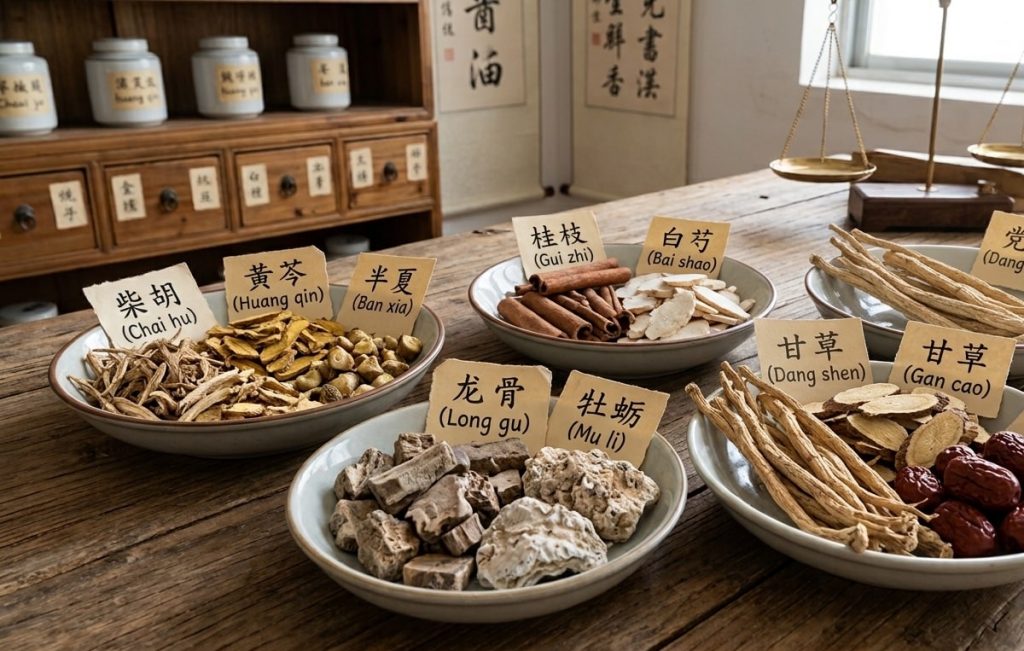
- Chai Hu (Bupleurum), Huang Qin (Scutellaria) and Ban Xia (Pinellia) harmonise the Shao Yang stage.
- Gui Zhi (Cinnamon Twig) and Bai Shao (White Peony) regulate the Ying and Wei levels while easing muscular and emotional tension.
- Long Gu (Dragon Bone) and Mu Li (Oyster Shell) are traditionally used to calm the Shen (mind) and help reduce palpitations and restlessness.
- Dang Shen (Codonopsis), Gan Cao (Liquorice) and Da Zao (Jujube) strengthen Qi and support the digestive system, helping create a more balanced internal environment.
No two patients receive exactly the same prescription. Depending on the individual’s presentation, I frequently modify the formula by adding herbs such as He Huan Pi (Mimosa Bark) or Yuan Zhi (Polygala Root) for anxiety and sleep, or Dan Shen (Salvia Root) where cardiovascular support is appropriate.
Who May Benefit?
This approach may be considered for people who experience:
- Heart palpitations or skipped beats
- A fluttering sensation in the chest
- Symptoms that are worse at night or while lying down
- Anxiety associated with palpitations
- Difficulty falling asleep because the heart feels unsettled
- Normal ECG or cardiology investigations, but ongoing symptoms
- Stress-related palpitations
- Poor sleep together with a racing heart
Every patient is assessed individually using a detailed consultation, pulse diagnosis, and tongue examination before any herbal prescription is recommended.
Clinical Cases From My Practice
Case 1 – Heart Flutter Following Surgery
A gentleman in his seventies attended after being admitted to hospital with atrial flutter several weeks following knee surgery. Poor sleep during recovery appeared to have contributed to the episode. Interestingly, he had experienced a similar event decades earlier that responded well to Chinese herbal medicine.
After medical assessment, we combined acupuncture with a modified Chai Hu-based herbal formula. His sleep improved first, followed by complete resolution of the fluttering sensation over subsequent treatments, with no recurrence reported during follow-up.
Case 2 – Night-time Heart Palpitations
A man in his late forties experienced skipped heartbeats almost exclusively when lying down at night. ECG findings were normal, and blood tests showed only minor variations. He also described waking with a racing heart, reduced energy, and increasing stress while raising young children.
Based on his TCM presentation, I prescribed a modified Chai Hu Gui Zhi Long Gu Mu Li Tang together with acupuncture and cupping therapy. Over the following weeks, both his palpitations and sleep improved steadily.
Case 3 – High Blood Pressure With Anxiety
A patient in his fifties sought treatment shortly after being diagnosed with hypertension. Alongside elevated blood pressure, he reported significant anxiety, irritability, and emotional tension.
Working alongside his prescribed medication, we used a modified herbal formula and regular acupuncture. Over several weeks, his blood pressure improved and he reported feeling noticeably calmer and sleeping better.
These cases are shared for educational purposes only. Individual results vary.
What Does the Research Say?
Modern research has explored Chai Hu Gui Zhi Long Gu Mu Li Tang for conditions including anxiety, insomnia, autonomic nervous system regulation, and certain cardiovascular symptoms. While early findings are encouraging, larger, high-quality clinical studies are still needed.
Traditional Chinese Medicine should be viewed as a complementary approach rather than a replacement for appropriate medical assessment and treatment.
Frequently Asked Questions
Can anxiety cause heart palpitations?
Yes. Anxiety can activate the body’s stress response, increasing adrenaline and making you more aware of your heartbeat. Many people notice fluttering or skipped beats during periods of stress, particularly at night.
Can Chinese herbs help heart palpitations?
Some patients find that carefully prescribed Chinese herbal medicine helps reduce anxiety, improve sleep, and decrease the frequency of functional palpitations. Treatment should always be individualised and provided by a qualified practitioner.
Is Chai Hu Gui Zhi Long Gu Mu Li Tang safe?
Like all herbal medicines, this formula should only be prescribed after a professional assessment. It may not be suitable for everyone, particularly those taking certain medications or with complex medical conditions.
When should I see a doctor?
Any new, persistent, or worsening heart palpitations should first be assessed by your GP or cardiologist. Immediate medical attention is required if palpitations occur with chest pain, fainting, severe shortness of breath, or other concerning symptoms.
Looking for Natural Support for Heart Palpitations?
If you’ve been told your heart is structurally healthy but you’re still experiencing anxiety, a fluttering heart, or recurring palpitations, Traditional Chinese Medicine may provide a complementary approach after appropriate medical assessment.
At Almond Wellness Centre, I combine detailed TCM diagnosis with acupuncture and individually prescribed Chinese herbal medicine to address the underlying pattern rather than simply the symptom.
Consultations are available at our Coburg and Ringwood clinics in Melbourne.
Reference
- Li C, Li B, Liu H, Qu L, Wang H. Mechanism of Chaihu Longgu oyster adjusted decoction for the treatment of depression based on network pharmacology and molecular docking technology. Ann Transl Med. 2023 Feb 22;11(4):172. doi:10.21037/atm-23-236. PMID: 36923088; PMCID: PMC10009556.
- Zhao Y, Xu D, Wang J, Zhou D, Liu A, Sun Y, Yuan Y, Li J, Guo W. The pharmacological mechanism of Chaihu-jia-Longgu-Muli-tang for treating depression: integrated meta-analysis and network pharmacology analysis. Front Pharmacol. 2023 Sep 21;14:1257617. doi:10.3389/fphar.2023.1257617. PMID: 37808199; PMCID: PMC10551636.
- Teng X, Sun L, Zhang B, Han Q, Jing T. Chaihu-Jia-Longgu-Muli Decoction improves dizziness with anxiety in rats by modulating tryptophan metabolism. J Ethnopharmacol. 2026 Feb 28;357:120881. doi:10.1016/j.jep.2025.120881.
- Liu A, Zhao Y, Sun Y, Halim JF, Zhou D, Yuan Y, Xu D, Li J, Guo W. Chaihu-Longgu-Muli decoction exerts antidepressant effects in rats by regulating the NLRP3 pathway. Pharmacol Res Mod Chin Med. 2025 Jun;15:100617. doi:10.1016/j.prmcm.2025.100617.