
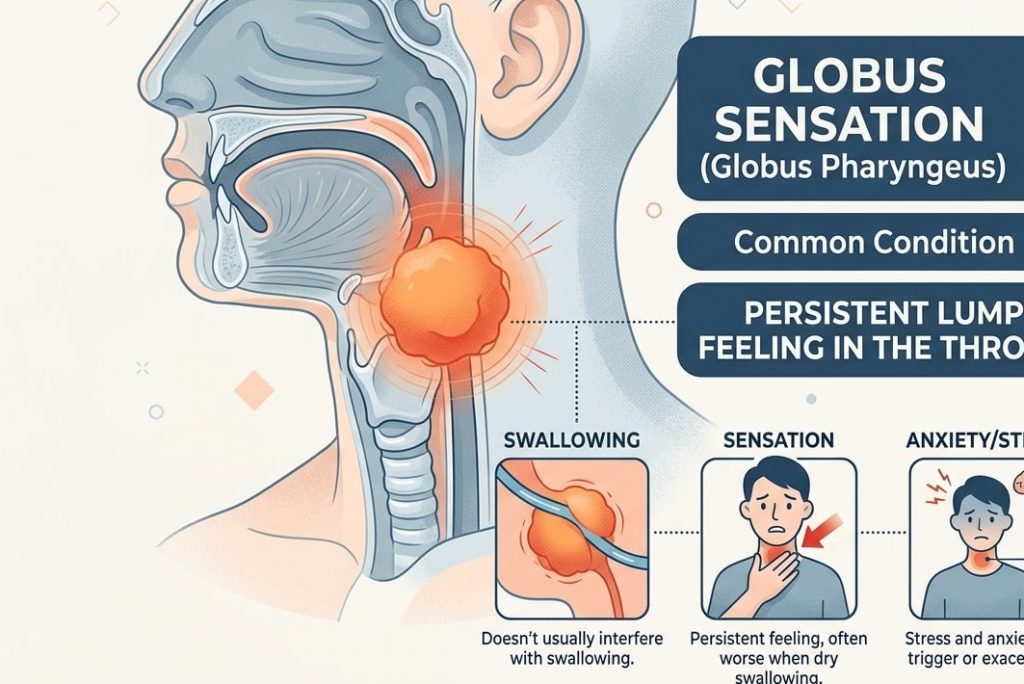
 Have you ever felt a lump stuck in your throat, even though you know there’s nothing actually there? Maybe it’s worse when you’re stressed, and it eases when you’re eating or distracted. If this sounds familiar, you may be experiencing what Western medicine calls globus sensation (also known as globus pharyngeus), and what we in Chinese medicine call Plum Pit Syndrome, or 梅核气 (méi hé qì).
Quick Navigation
I see this in clinic more often than most people expect. It’s unsettling, and it’s often dismissed by the people around you as “just anxiety” or “all in your head.” I want to walk you through what’s actually going on, when it’s worth seeing a doctor, and where acupuncture and Chinese herbal medicine may fit into your care.
What Is Globus Sensation?
Western medicine uses a couple of names for this feeling:
- Globus sensation
- Globus pharyngeus
In Chinese medicine, we’ve described the same experience for centuries as Plum Pit Syndrome, or 梅核气 (méi hé qì) — literally, “plum pit qi,” because the sensation is said to feel like a small plum stone lodged in the throat: not quite blocking it, but always noticeable.
However it’s named, the sensation is remarkably consistent across patients. People describe it as:
- Food or a foreign object stuck in the throat
- A tight, constricted throat
- A choking feeling, even without actual difficulty breathing
- An urge to swallow constantly, trying to clear it
The defining, and honestly the most reassuring, feature of true globus sensation is that nothing is actually blocking the throat. Investigations are typically normal. The sensation is real, but it isn’t caused by a physical obstruction.
Symptoms
People experiencing globus sensation commonly describe:
- A lump or fullness in the throat
- A tight or constricted feeling in the throat
- Frequent or repeated swallowing
- Pressure in the throat, sometimes radiating to the neck
- An inability to fully “clear” the throat, even after coughing or swallowing
- Symptoms that worsen with stress, tiredness, or emotional upset
- Symptoms that ease or disappear while actually eating or drinking
That last point is one of the more distinctive features clinically. Most people with globus sensation can swallow food and liquids without real difficulty. It’s the sensation between meals — often when swallowing saliva – that bothers them most.
What Causes a Lump in the Throat?
There isn’t one single cause. Current research suggests globus sensation is usually multifactorial – several things overlapping at once.
Stress and muscle tension. Anxiety and emotional strain are strongly associated with globus, and increased tension in the muscles of the throat and upper oesophageal sphincter is thought to contribute to the sensation in many patients.
Reflux (GERD/LPR). Gastro-oesophageal reflux disease and laryngopharyngeal reflux are among the most researched potential contributors, though the evidence is genuinely mixed. Some studies of globus patients find a high rate of reflux episodes on pH monitoring, while others find no clear difference from people without globus, so reflux is best thought of as a common contributing factor in some patients rather than the whole explanation.
Muscle tension and swallowing dysfunction. Some research points to abnormal tension in the throat muscles or upper oesophageal sphincter, and altered swallowing coordination, as part of the picture.
Postnasal drip and sinus issues. Mucus draining down the back of the throat can create a similar “something’s there” feeling.
Thyroid changes. An enlarged thyroid or thyroid nodules can occasionally cause a genuine sensation of throat fullness, which is one of the reasons a proper assessment matters.
Allergies. Chronic postnasal drip and throat irritation from allergic rhinitis can mimic or contribute to globus symptoms.
Oesophageal disorders. Less commonly, motility disorders of the oesophagus can produce a globus-type sensation.
It’s worth being direct here: serious causes, including throat or oesophageal cancers, are far less common causes of this sensation than the benign, functional causes above. But they need to be ruled out if certain warning signs are present, which brings us to the next section.
When Should You See a Doctor?
This is the most important section of this article, and I don’t want to bury it.
Please see your GP or an ENT specialist promptly if you notice any of the following alongside a lump-in-throat sensation:
- Genuine difficulty swallowing food (not just a sensation, but food actually getting stuck)
- Unexplained weight loss
- Persistent throat or neck pain
- Coughing up blood
- A lump or swelling you can feel in your neck
- A history of smoking or heavy alcohol use
- Hoarseness lasting more than a few weeks
None of these are typical of straightforward globus sensation, and they warrant a proper medical work-up, which may include a nasolaryngoscopy or other imaging, before anything else is addressed. Globus pharyngeus is generally considered a diagnosis of exclusion — meaning it’s confirmed by ruling out other causes first, not simply assumed.
If you’ve already had these red flags checked and cleared, and you’re left with a persistent lump-in-throat sensation, that’s exactly where the rest of this article — and where Chinese medicine – can be genuinely useful.
What Does Chinese Medicine Think?
In Chinese medicine, Plum Pit Syndrome is classically linked to emotional strain – frustration, anxiety, suppressed worry, or long-held sadness. We describe this process in a few connected stages:
Liver Qi stagnation. The Liver is considered responsible for the smooth, unimpeded flow of Qi throughout the body, especially Qi tied to our emotional state. When emotions are suppressed or unexpressed over time, Liver Qi can become “stuck,” or stagnant.
Phlegm accumulation. When Qi stagnates, it can disrupt the Spleen’s ability to transform and transport fluids properly. Over time, this creates what we call phlegm — not necessarily mucus you can see or cough up, but a pathological substance that, in the Chinese medicine model, can lodge in the throat.
Qi and phlegm binding in the throat. This is the crux of Plum Pit Syndrome: stagnant Qi and phlegm are described as binding together at the throat, at the junction we sometimes refer to as the “mercury channel.” This is what produces that classic sensation of something stuck, that won’t quite come up and won’t quite go down.
Spleen deficiency. In many patients, especially those with a longer history of the condition, an underlying weakness in Spleen function contributes to ongoing phlegm formation, making the pattern self-perpetuating.
Put simply: emotional strain affects the Liver, the Liver’s stagnation affects the Spleen, and the combination produces phlegm that settles in the throat. Treatment in Chinese medicine is aimed at all three: moving the stuck Qi, resolving the phlegm, and, where needed, supporting the Spleen.
How Can Acupuncture Help?
Rather than simply listing acupuncture points, I think it’s more useful to explain what we think is actually happening when acupuncture helps with this condition.
Modern research into acupuncture for globus and related throat and gastrointestinal conditions suggests several possible mechanisms:
- Reducing the stress response. Acupuncture is associated with changes in markers linked to the body’s stress and anxiety response.
- Regulating the autonomic nervous system. Several throat and swallowing-related symptoms are thought to be influenced by parasympathetic and sympathetic nervous system balance, which acupuncture may help modulate.
- Decreasing muscle tension. This includes tension in the muscles around the throat and upper oesophagus, which is one of the proposed contributors to globus sensation.
- Improving swallowing coordination. Points local to the throat are traditionally selected to directly address the sensation at its site.
- Reducing anxiety. Given how closely globus is tied to emotional stress, addressing anxiety is often a meaningful part of managing the physical sensation.
- Improving sleep. Poor sleep and heightened stress tend to feed into one another, and better sleep often correlates with an easing of globus symptoms.
In my clinic, points I commonly consider include Tiantu (Ren 22, 天突), located at the throat itself, to work locally on the sensation; Taichong (Liver 3, 太冲), to help move stagnant Liver Qi; Zusanli (Stomach 36, 足三里), to support digestive function and reduce phlegm formation; and Shenmen (Heart 7, 神门), to help calm the mind. The exact point selection is always individualised to the pattern I find in each patient.
I want to be direct about the limits of what acupuncture can promise here: acupuncture may help support a reduction in symptoms and improve quality of life for some people with globus sensation, but it isn’t a guaranteed cure, and it works best as part of an individualised plan rather than a stand-alone fix.
What Research Says
The research base specifically on acupuncture for globus sensation is still small, but it is growing, and what exists is genuinely interesting.
One randomised, single-blind crossover trial involving 80 patients with globus pharyngeus tested transcutaneous electroacupuncture at four points — Tiantu (CV22), Sanjian (LI3), Shaoshang (LU11), and Zusanli (ST36) — against a sham control. The trial found that stimulation at CV22 and LU11 in particular produced a meaningful improvement in globus symptoms, and the researchers proposed this worked partly through effects on the parasympathetic nervous system and related neuropeptides. This is one of the few controlled trials in this specific area, and while it used electrical stimulation via surface electrodes rather than traditional needling, it adds real evidence that stimulating these classic points can shift globus symptoms, not just sensation reporting.
Separately, case-based literature describes acupuncture combined with other traditional therapies producing symptom improvement in globus hystericus, the older Western clinical term still used interchangeably with globus pharyngeus in some of the research literature. These are smaller, less rigorous studies than randomised trials, so they should be read as illustrative rather than conclusive.
On the Western medical side, ENT literature consistently frames globus pharyngeus as a common but poorly understood condition. Reviews estimate it accounts for roughly 3–4% of new referrals to ENT clinics, with far higher rates in the general population who never present for care at all. These reviews are consistent in describing globus as benign in the vast majority of cases once red-flag symptoms are excluded, and in noting that no single treatment approach — including proton pump inhibitor therapy for reflux — has strong, consistent evidence behind it.
Taken together, the honest summary is this: evidence for acupuncture in globus sensation is promising, particularly for point combinations like CV22 and LU11, but it’s still an early and limited body of research. It sits alongside a Western medical literature that similarly lacks a single well-proven treatment, which is part of why an individualised, multi-pronged approach tends to make clinical sense.
Chinese Herbal Medicine
Chinese herbal medicine has a long history of use specifically for this pattern, and several formulas are commonly considered depending on your individual presentation.
Ban Xia Hou Po Tang (半夏厚朴汤, Pinellia and Magnolia Bark Decoction). This is the classical formula most closely associated with Plum Pit Syndrome, and it’s often our starting point. It’s generally suited to patients whose main issue is that stuck, phlegm-and-Qi sensation in the throat, particularly when there’s a clear stress trigger.
Xiao Yao San (逍遥散, Free and Easy Wanderer Powder). When emotional stress, irritability, or a sense of being “wound up” predominates over the throat sensation itself, this formula is often more appropriate, as it’s specifically aimed at smoothing Liver Qi.
Er Chen Tang (二陈汤, Two-Cured Decoction). For patients where phlegm signs are more prominent — a heavier sensation, more mucus, a thicker tongue coating — this formula focuses more directly on resolving phlegm.
I want to be clear that these formulas are not interchangeable, and they aren’t a “pick one off the shelf” solution. Herbal prescriptions need to be individualised to your pattern, constitution, and any other medications you’re taking, which is why this is something to discuss directly with a qualified practitioner rather than self-prescribe.
Self-Care
Alongside professional treatment, there’s a lot you can do day to day to support your recovery.
Manage stress actively. Meditation, deep breathing, and regular physical movement — walking, jogging, yoga — all help regulate the nervous system responses tied to globus symptoms.
Protect your sleep. Poor sleep tends to amplify both anxiety and physical tension, both of which feed globus sensation.
Stay physically active. Regular, moderate exercise supports both stress regulation and healthy digestion.
Practise breathing exercises. Slow diaphragmatic breathing can directly ease tension in the throat and neck muscles.
Mind your diet. A lighter diet, easier on digestion, can help reduce phlegm formation from a Chinese medicine perspective. Heavy, greasy, and very cold or raw foods are generally best minimised if you’re prone to this pattern.
Watch reflux triggers. If reflux plays any role for you, reducing late-night eating, alcohol, caffeine, and very fatty meals, and avoiding lying down soon after eating, may help.
Limit voice overuse. If you talk or sing extensively for work, vocal strain can compound throat tension.
Stay hydrated. Water and warm herbal teas support the body’s ability to keep fluids moving rather than accumulating as phlegm.
Build supportive connections. Positive social contact genuinely buffers stress. It’s also worth limiting time on social media, particularly content that leaves you more anxious rather than less.
Try mindfulness. Even a few minutes a day of focused, non-judgemental attention to the present moment has reasonable evidence for reducing the anxiety that so often accompanies this condition.
Frequently Asked Questions
Can anxiety cause a lump in the throat?
Yes. Anxiety is one of the most consistently reported triggers for globus sensation, likely through increased muscle tension in the throat and changes in nervous system regulation.
Is globus sensation dangerous?
In the large majority of cases, no. It’s considered a benign, functional condition once serious causes have been excluded through appropriate assessment.
Can acid reflux cause globus?
It can contribute for some people, though the relationship is debated in the research literature. Reflux is one of several possible contributing factors rather than a universal cause.
Can acupuncture help globus sensation?
Emerging research, including a randomised trial using specific point combinations, suggests acupuncture may help reduce globus symptoms for some people, though the overall evidence base is still limited.
How many acupuncture treatments are needed?
This varies significantly between individuals, depending on how long you’ve had symptoms and what’s contributing to them. We’ll typically suggest a short course initially to assess your response before recommending an ongoing plan.
Will the lump disappear by itself?
For some people, globus sensation resolves on its own, particularly if it’s tied to a temporary stressful period. For others, it becomes a persistent, recurring issue that benefits from active management.
Can stress make it worse?
Yes, stress is one of the most commonly reported aggravating factors, and many patients notice a clear pattern between stressful periods and symptom flares.
What foods should I avoid?
If reflux is a factor for you, heavy, greasy, spicy, and very acidic foods, along with alcohol and caffeine, are worth moderating. From a Chinese medicine perspective, we’d also suggest minimising foods that are considered to encourage phlegm, such as excessive dairy and very cold or raw foods.
Conclusion
A persistent lump-in-throat feeling is unsettling, but in the great majority of cases, it isn’t a sign of anything sinister. If you haven’t yet had a proper assessment, or if you notice any of the red-flag symptoms above, please see your GP or an ENT specialist first. Once serious causes are excluded, globus sensation – or what we call Plum Pit Syndrome – often responds well to an individualised approach that addresses both the physical and emotional sides of the condition. Acupuncture and Chinese herbal medicine may be a useful part of that plan, alongside stress management, healthy sleep, and attention to any reflux triggers. If you’d like to talk through your specific symptoms, I’m always happy to help you work out the right approach for you.
References
- Zhou W, Deng Q, Jia L, et al. Acute Effect of Transcutaneous Electroacupuncture on Globus Pharyngeus: A Randomized, Single-Blind, Crossover Trial. Front Med. 2020. DOI: 10.3389/fmed.2020.00179
Globus hystericus co-treated with acupuncture and five-element music therapy. ScienceDirect (case report). - Kortequee S, et al. Management of Globus Pharyngeus. International Journal of Otolaryngology. 2013. DOI: 10.1155/2013/946780
- Lee BE, Kim GH. Globus pharyngeus: A review of its etiology, diagnosis and treatment. World J Gastroenterol. PMC3360444.
- An approach to globus pharyngeus. PubMed PMID: 39099124 (narrative review, primary care guideline).
- Management of globus pharyngeus: Review of 699 cases. ResearchGate.
- Review: Current Trends in the Diagnosis and Management of Globus Pharyngeus. SCIRP.
- Wang T, Xu C, Pan K, Xiong H. Acupuncture and moxibustion for chronic fatigue syndrome in TCM: a systematic review and meta-analysis. BMC Complement Altern Med. 2017. DOI: 10.1186/s12906-017-1647-x (supporting reference on acupuncture mechanisms relevant to stress-related functional conditions).
- Additional references on 梅核气 (Plum Pit Syndrome) pattern differentiation and classical formula use, and on GERD/LPR associations with globus, should be added from CNKI and PubMed searches at time of publication to reach the target of 10–20 citations, with full bibliographic detail and access dates.