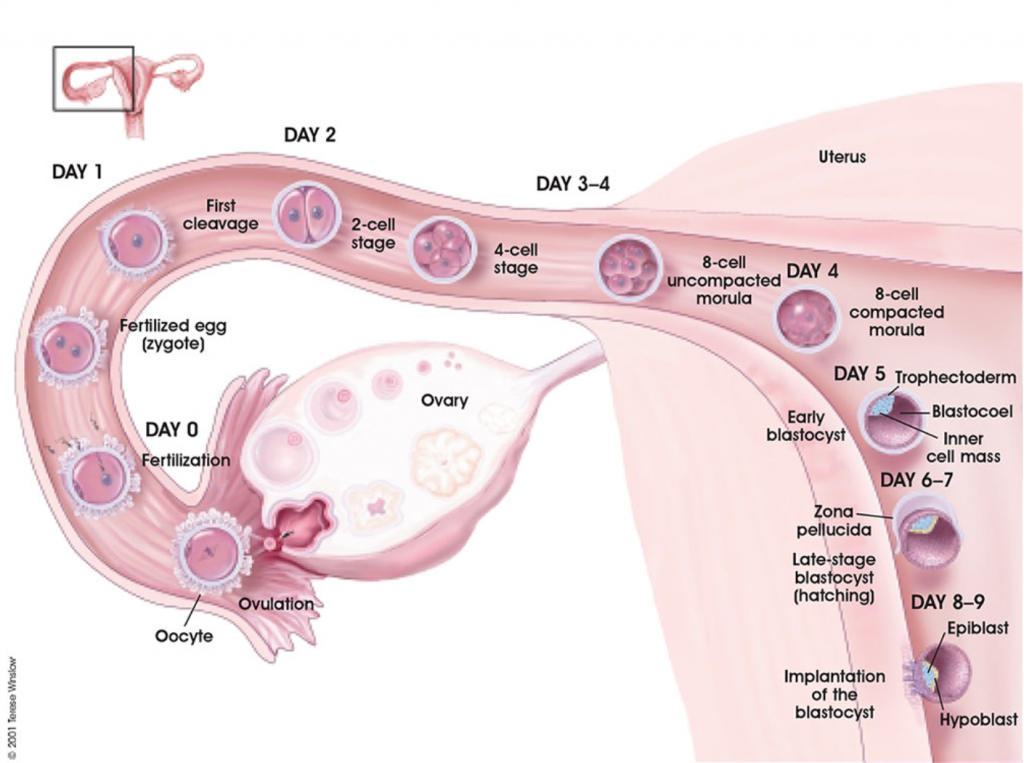
The journey from fertilisation to embryo implantation is truly amazing:
1. Fertilisation: First, during ovulation, a healthy egg meets a healthy sperm, creating a single-cell embryo.
2. Traveling to the Uterus: Next, the embryo begins its journey towards the uterus. While traveling, it divides into more cells, gradually moving through the fallopian tube. This phase lasts about 4 to 5 days.
Key Milestone
Once the embryo reaches the uterus, it starts the implantation process. This crucial step takes about 2 to 3 days.
Successful implantation means the embryo has attached to the uterine lining. This step is essential for pregnancy. After implantation, the placenta begins to form and produces hCG, the pregnancy hormone.
About 10 days after fertilisation, hCG can be detected in the blood. However, since home pregnancy tests measure hCG in urine, it may take a little longer for them to show a positive result.
Signs of Implantation
During this stage, some women may notice mild symptoms like lower abdominal pain, tingling, bloating, or slight vaginal bleeding. These are normal signs of implantation.
About 20 to 30 days after implantation, or 35 to 40 days after the last menstrual period, an ultrasound can detect a gestational sac, confirming pregnancy.
A Miraculous Journey
In summary, the entire process from fertilisation to implantation takes around 6 to 10 days. Therefore, about 10 days after intercourse, women can check for pregnancy using hCG tests. This marks the beginning of a miraculous journey of life, filled with hope and vitality.
References
Blesa D, Ruiz-Alonso M, Simon C. Clinical management of endometrial receptivity. Semin Reprod Med. 2014;32:410–413.
Donaghay M, Lessey BA. Uterine receptivity: alterations associated with benign gynecological disease. Semin Reprod Med. 2007;25:461–475.
Psychoyos A. Hormonal control of ovoimplantation. Vitam Horm. 1973;31:201–256.
“Can I still have acupuncture when I’m on my period? Will it affect my menstrual flow?”
It’s a question I hear often, so I want to walk through how I think about it.
In my clinical experience, for most people, having acupuncture during their period isn’t, by itself, a reason to postpone treatment. That said, I always individualise treatment according to your symptoms, health, menstrual flow and the reason you’re seeking care.
Some patients worry that acupuncture might increase menstrual bleeding or interfere with the normal cycle. Others wonder whether they should avoid treatment altogether while menstruating, particularly if they’re trying to conceive or undergoing fertility treatment.
My answer is usually more straightforward than people expect: being on your period doesn’t automatically mean you need to avoid acupuncture.
What Does the Research Say About Acupuncture During Menstruation?
In my view, there’s no strong evidence that menstruation itself is a reason to routinely avoid acupuncture.
A published discussion specifically examining the question of acupuncture during menstruation found no clear evidence that treatment should be avoided simply because someone is having their period.¹
Acupuncture has also been studied for menstrual pain. A 2024 network meta-analysis of 70 randomised controlled trials involving 5,772 participants found potential benefits of acupuncture-related therapies for primary dysmenorrhoea. However, the authors noted that the quality of the included evidence was generally low, so the findings should be interpreted with caution.²
More recently, a 2025 systematic review and meta-analysis included 22 randomised controlled trials involving 1,955 participants. The review found that acupoint stimulation may reduce pain intensity in primary dysmenorrhoea, and it did not find a significant difference in adverse-event rates compared with control groups. However, the certainty of the evidence ranged from low to moderate because of limitations including risk of bias and substantial heterogeneity between studies.³
Importantly, these studies mainly concern acupuncture or acupoint stimulation for primary dysmenorrhoea (period pain).
That’s an important distinction for me to make clear.
It doesn’t mean acupuncture is right for everyone in every situation, and it doesn’t mean it’s completely free of possible adverse reactions. As with any healthcare treatment, I consider each person’s individual circumstances.
That’s why I always want to know about your menstrual cycle, your symptoms and any relevant medical conditions before I begin treatment.
Can Acupuncture Make Your Period Heavier?
This is one of the most common concerns I hear from patients.
In my experience, and based on the available evidence, there’s no good indication that simply having acupuncture while menstruating routinely causes heavier bleeding.
That said, menstrual flow naturally varies between people and from one cycle to the next. If your period is unusually heavy, prolonged or significantly different from your normal pattern, I wouldn’t want you to assume acupuncture is the cause.
Very heavy menstrual bleeding can sometimes point to an underlying gynaecological or medical issue, and I’ll often suggest it’s assessed by your doctor.
Please let me know if you:
normally have very heavy menstrual bleeding
have a known bleeding disorder
take anticoagulant or antiplatelet medication
are feeling unusually weak, dizzy or unwell
have recently noticed a significant change in your menstrual pattern.
With that information, I can decide whether acupuncture is appropriate that day and whether to adjust my approach.
Can Acupuncture Help With Period Pain?
Many patients come to me specifically for help with menstrual pain and cramps.
Acupuncture has been studied for primary dysmenorrhoea, and systematic reviews have reported potential reductions in pain. I’d caution, though, that the evidence isn’t uniform — some reviews highlight limitations like study quality, heterogeneity and risk of bias.
From a Chinese medicine perspective, I don’t treat someone a certain way simply because they’re menstruating — treatment is individualised. In cases of period pain with clotting, for example, I’m often thinking about 血瘀 (xuè yū), or “Blood stasis,” and selecting points accordingly.
I’ll typically consider:
the severity and location of your menstrual pain
whether pain occurs before, during or after your period
menstrual flow and clotting
the length and regularity of your cycle
associated symptoms such as bloating, headaches, fatigue or nausea
your general health and treatment goals.
If period pain is severe, new or getting worse, I also think about whether further medical assessment is needed. Conditions like endometriosis, adenomyosis or fibroids can cause significant menstrual pain and shouldn’t be overlooked.
Acupuncture During Your Period When Trying to Conceive
If you’re trying to conceive, having your period usually doesn’t mean you need to stop acupuncture.
In fertility care, I often adapt treatment timing according to where you are in your cycle, your symptoms, your fertility history, and whether you’re trying to conceive naturally or undergoing assisted reproductive treatment.
For some patients, I’ll include acupuncture during menstruation as part of an ongoing treatment plan. For others, the emphasis of treatment shifts as the cycle progresses.
There’s no single acupuncture schedule that’s right for everyone – this is something I work out with each patient individually.
Does Acupuncture Timing Matter During the Menstrual Cycle?
The menstrual cycle isn’t just one event to me – it moves through different stages, and your symptoms and treatment goals often change throughout it. This is close to the idea of 调经 (tiáo jīng), or “regulating the menstrual cycle,” where I adjust my approach according to each phase rather than treating every visit the same way.
During menstruation
Some patients see me during their period specifically for pain, discomfort or other symptoms. Others simply continue with acupuncture as part of an established treatment plan.
Being on your period alone doesn’t generally mean I’ll cancel treatment.
After menstruation
Once your period has finished, I’ll often adjust treatment according to your symptoms, cycle pattern and treatment goals.
For someone seeking fertility support, this tends to be part of a broader plan rather than a separate treatment just because the period has ended.
Around ovulation
My timing looks different for someone trying to conceive naturally compared with someone undergoing assisted reproductive treatment.
Rather than following a rigid calendar, I individualise this.
After ovulation
The focus can shift again depending on your symptoms and circumstances.
For patients undergoing IVF, I also take your fertility clinic’s treatment schedule into account when timing acupuncture.
The key point I’d want you to take away is that there’s no universal “best day” of the cycle for acupuncture. I base timing on the reason for treatment and your individual circumstances.
When Should You Postpone Acupuncture or Seek Medical Advice?
Menstruation itself isn’t usually a reason to cancel your appointment with me.
But do let me know if you’re feeling unwell, or if something about your period feels significantly different from usual.
I’d encourage you to seek medical assessment if you experience:
unusually heavy or prolonged menstrual bleeding
severe or rapidly worsening pelvic pain
fainting or significant dizziness
unexplained bleeding between periods
a sudden major change in your menstrual cycle
symptoms that concern you or fall outside your normal pattern.
I don’t see acupuncture as a substitute for medical assessment when a new or potentially significant symptom needs investigating.
What I’ll Ask You Before Treatment
Before we start, it’s useful for me to know:
that you’re currently menstruating
roughly which day of your cycle you’re on
whether your flow is light, moderate or unusually heavy
whether you have menstrual pain
whether you’re trying to conceive
whether you’re undergoing IVF or another fertility treatment
any relevant medications or medical conditions.
This helps me make an appropriate clinical assessment and choose a treatment approach that suits you that day. I’ll also adjust treatment if you’re feeling particularly sensitive, tired, or uncomfortable.
Frequently Asked Questions
Can I have acupuncture while I’m on my period?
For most people, yes – menstruation itself isn’t a reason to avoid acupuncture. I’ll still consider your symptoms, health and reason for treatment before proceeding.
Can acupuncture make my period heavier?
There’s no good evidence that acupuncture routinely causes heavier bleeding simply because treatment is given during menstruation. If your bleeding is unusually heavy or has changed significantly, I’d suggest discussing this with your GP.
Can I have acupuncture during my period if I’m trying to get pregnant?
Yes. Menstruation doesn’t automatically rule out acupuncture as part of a fertility care plan – I adapt treatment timing according to your cycle, symptoms and fertility treatment.
Should I stop acupuncture when my period starts?
Not necessarily. If you’re already receiving acupuncture as part of an ongoing plan, I’ll usually continue and adjust according to your symptoms and circumstances.
Can I have acupuncture during IVF when I have my period?
I often use acupuncture as an adjunct to IVF care, but the timing needs to take your individual IVF protocol and fertility clinic schedule into account. It’s worth discussing complementary treatment with your fertility team.
Is acupuncture helpful for period pain?
I’ve seen it help many patients, and some systematic reviews report potential benefits. That said, evidence quality varies, so I can’t guarantee individual outcomes.
Should I have acupuncture if my period is unusually heavy or painful?
Tell me about your symptoms before we start. If the bleeding or pain is significantly different from your normal pattern- particularly if it’s severe or comes with dizziness or weakness – I’d also suggest medical assessment.
Bottom Line
For most people, being on your period doesn’t automatically mean acupuncture should be avoided.
What matters to me isn’t simply whether you’re menstruating, but why you’re having acupuncture, how you’re feeling, your menstrual symptoms and your overall health.
If you’re having acupuncture during your period, tell me where you are in your cycle and whether anything feels different from usual. I can then assess whether treatment is appropriate and adapt my approach where needed.
If you’re trying to conceive, I’ll often think about the timing and focus of acupuncture as part of your broader fertility care plan, rather than simply avoiding treatment during menstruation.
I see acupuncture as complementary care where appropriate – it shouldn’t replace medical investigation or treatment when that’s what’s needed.
References
Ying Lin, Hong Zhang, Thinking About Acupuncture During Your Period. 2016. PMID: 27323450. https://pubmed.ncbi.nlm.nih.gov/27323450/
Chen B, Liu S, Jin F, Li T, Yang N, Xu Y, et al. Efficacy of acupuncture-related therapy in the treatment of primary dysmenorrhea: a network meta-analysis of randomized controlled trials. Heliyon. 2024;10(10):e30912. doi:10.1016/j.heliyon.2024.e30912.
Wang Y, Liu L, Wu X, Wu Y, Qin R, Wang M, et al. Clinical evidence of acupoint stimulation for primary dysmenorrhea: a systematic review and updated meta-analysis. J Pain Res. 2025;18:4307-4336. doi:10.2147/JPR.S533585. PMID:40893121.
Have you noticed light spotting around the middle of your menstrual cycle and wondered, “Is this another period?”
Some women experience light bleeding or spotting around the time of ovulation. It can be particularly noticeable when you are tracking your cycle closely while trying to conceive.
In my clinic, women often ask whether this type of mid-cycle bleeding is normal, whether it can affect fertility, and whether acupuncture or Chinese medicine may help. The first step is to understand the pattern and consider whether further medical assessment is appropriate.
What Is Ovulation Bleeding?
Ovulation bleeding generally refers to light spotting that occurs around the time of ovulation, rather than during the expected menstrual period. It may appear as a small amount of pink, red or brown blood, sometimes mixed with cervical mucus. Some women also notice mild pelvic discomfort around the same time.
The timing of ovulation differs from woman to woman and can vary from cycle to cycle. It is therefore better to think of this as mid-cycle spotting around ovulation rather than assuming it always occurs on a particular day, such as day 14.
Hormonal changes around ovulation may contribute to light spotting in some women. However, bleeding between periods can have other causes as well, so recurrent or unexplained bleeding should not automatically be attributed to ovulation.
What Does Ovulation Spotting Usually Look Like?
Ovulation spotting is generally:
Much lighter than a normal menstrual period
Short-lived, often lasting a day or two
Pink, red or brown in colour
Sometimes mixed with cervical mucus
Occasionally accompanied by mild pelvic discomfort
Every menstrual cycle is different. If the bleeding is heavy, lasts longer than expected, happens frequently, or represents a new change in your usual cycle, it is worth discussing it with your GP or gynaecologist.
Does Ovulation Bleeding Affect Fertility?
Occasional light spotting around ovulation does not necessarily mean there is a fertility problem.
For women trying to conceive, however, recurrent mid-cycle bleeding is worth paying attention to, particularly when it occurs alongside irregular cycles, difficulty identifying ovulation, pelvic pain or other changes in the menstrual cycle.
The bleeding itself is only one part of the picture.
When I assess a woman for fertility, I may consider:
Menstrual cycle length and regularity
Ovulation patterns
Cervical mucus
Basal body temperature
Premenstrual symptoms
Mid-cycle pain or spotting
Previous pregnancies or miscarriages
PCOS or endometriosis
Previous fertility treatment
Blood test results and ultrasound findings
General health, sleep and stress
If you are trying to conceive, keeping a simple record of when spotting occurs can be useful.
When Should You See Your Doctor?
Not all bleeding between periods is ovulation bleeding.
I recommend discussing mid-cycle bleeding with your GP or gynaecologist if it is:
Heavy or increasing
Persistent or recurrent
Associated with significant pelvic pain
Occurring after sexual intercourse
Associated with unusual vaginal discharge or other symptoms
A new change in your usual menstrual pattern
Occurring when pregnancy is possible
There are many possible causes of bleeding between periods, including hormonal changes, contraception, cervical conditions, infections, polyps, fibroids, endometriosis and other gynaecological conditions.
Your doctor can determine whether examination, blood tests, ultrasound or other investigations are appropriate.
A Traditional Chinese Medicine Perspective
Traditional Chinese medicine approaches the menstrual cycle differently from Western medicine.
In TCM, the cycle is viewed as a dynamic interaction between Qi (气, qì), Blood (血, xuè), Yin (阴, yīn) and Yang (阳, yáng).
Ovulation represents an important transition within the menstrual cycle. From a TCM perspective, the smooth movement and transformation of Qi and Blood during this transition may be considered when assessing mid-cycle spotting.
Depending on the individual presentation, a TCM practitioner may consider patterns involving:
Qi and Blood stagnation
Qi or Blood deficiency
Kidney (肾, shèn) and Spleen (脾, pí) deficiency
Yin-Yang imbalance
Cold or other patterns affecting the movement of Blood
These are TCM diagnostic frameworks rather than biomedical explanations for why bleeding occurs.
This distinction matters. A TCM assessment does not replace medical investigation when there is unexplained or persistent bleeding.
How I Approach This in the Clinic
I don’t use a single acupuncture protocol for ovulation spotting.
Two women may both describe “bleeding around ovulation” but have completely different menstrual histories, fertility goals, symptoms and medical backgrounds.
During a consultation, I may look at:
When the spotting occurs in relation to ovulation
How much bleeding there is and how long it lasts
Your menstrual cycle as a whole and ovulation signs
Pain and other menstrual symptoms
Previous diagnoses and fertility history
Blood tests and ultrasound findings
Sleep, stress, digestion and general wellbeing
Traditional Chinese medicine assessment may also include pulse and tongue examination.
Acupuncture treatment is then individualised according to the overall presentation rather than simply treating the symptom of spotting.
Depending on the individual, acupuncture may be incorporated into a broader fertility program focused on menstrual cycle support, reproductive wellbeing, stress management and preconception care.
Chinese herbal medicine may also be considered in some circumstances, taking into account any conventional medications or fertility treatment.
Can Acupuncture Help With Ovulation and Fertility?
Acupuncture is commonly used as a complementary therapy by women preparing for natural conception and by patients undergoing assisted reproductive treatment.
For someone trying to conceive naturally, treatment may be planned around the menstrual cycle and ovulation.
For someone undergoing IVF, acupuncture may be incorporated into different stages of treatment, including pre-IVF preparation, ovarian stimulation and around embryo transfer, depending on individual circumstances and the fertility treatment plan.
The aim is not to promise a particular fertility outcome.
Rather, acupuncture and Chinese medicine can be considered as part of an individualised approach to supporting reproductive health and wellbeing alongside appropriate medical care.
Acupuncture Alongside Your GP or Fertility Specialist
I believe fertility care works best when different healthcare professionals work within their respective areas of expertise.
If you are experiencing recurrent ovulation spotting, your GP or fertility specialist can investigate possible medical causes. Acupuncture and Chinese medicine can then be incorporated as complementary care where appropriate.
For women trying to conceive, this may include support for natural conception, preconception preparation, menstrual cycle concerns or the physical and emotional demands of fertility treatment.
For patients undergoing IVF, acupuncture treatment can be planned around the fertility specialist’s protocol rather than replacing it.
If you are taking fertility medications, supplements or Chinese herbal medicine, it’s important that your healthcare providers know what you’re taking.
Tracking Your Cycle Can Help
If you are concerned about ovulation spotting, start by keeping a simple record for a few cycles.
Note:
The first day of your period and your cycle length
When spotting occurs, including its colour and amount
Ovulation predictor kit results, if used
Changes in cervical mucus
Basal body temperature, if you track it
Any pelvic pain or other symptoms
This information can help you and your healthcare practitioner identify patterns and decide whether further assessment is needed.
Frequently Asked Questions
Is ovulation bleeding a sign of pregnancy?
Ovulation spotting occurs around the time of ovulation, before a pregnancy could be established from that same cycle, so it is not considered a sign of pregnancy.
Some women notice light bleeding later in the cycle, sometimes referred to as “implantation bleeding”. However, bleeding in early pregnancy can have several causes, so if you are pregnant or think you may be pregnant and experience bleeding, speak with your GP or other appropriate healthcare professional.
Can stress cause ovulation spotting?
Stress can affect the menstrual cycle and may contribute to changes in cycle regularity or ovulation. However, it should not automatically be assumed to be the direct cause of spotting.
From a TCM perspective, stress may be considered alongside other factors affecting the movement of Qi and Blood. Stress management may therefore form part of a broader approach to menstrual and reproductive wellbeing.
How is ovulation bleeding different from a light period?
Ovulation spotting typically occurs around the middle of the cycle, is lighter than a menstrual period and often resolves within a day or two.
A menstrual period usually follows the expected end of the cycle and is generally heavier and longer.
Tracking your cycle over several months can help you identify your usual pattern. If bleeding becomes unusual for you, it is worth discussing with your GP or gynaecologist.
Can acupuncture help with ovulation spotting?
Acupuncture may be considered as complementary care after appropriate medical assessment, particularly when mid-cycle spotting occurs as part of a broader menstrual or fertility concern.
Treatment is individualised according to your menstrual history, symptoms, fertility goals and overall health rather than using a single protocol for everyone.
Can I have acupuncture while undergoing IVF?
Acupuncture may be incorporated alongside IVF treatment, including during pre-IVF preparation, ovarian stimulation and around embryo transfer, depending on your individual circumstances.
Your acupuncture practitioner should be aware of your IVF protocol and medications, and acupuncture should complement rather than replace the treatment plan provided by your fertility specialist.
Related Fertility Services at Almond Wellness Centre
Natural Fertility Acupuncture
Acupuncture and Chinese medicine support for women preparing for natural conception and preconception care.
If you are experiencing mid-cycle bleeding and are unsure whether it is related to ovulation, speak with your GP or fertility specialist for appropriate assessment.
If you are also interested in acupuncture, contact Almond Wellness Centre to discuss how complementary Chinese medicine care may fit alongside your existing fertility treatment.
In Western medicine, a “normal” menstrual cycle is often defined by numbers: a 28-day cycle, bleeding for 3 to 7 days, and a volume of 30–50ml. However, at Almond Wellness Centre, we believe a truly healthy period is about more than just the calendar – it is a window into the harmony of your Zang-Fu organs, the strength of your Qi and Blood, and the flow within the Chong and Ren vessels.
As a practitioner with over 30 years of experience, I often tell my patients: “Your period is a monthly report card of your internal health.” If the report card shows pain, clots, or irregular timing, it’s your body’s way of asking for balance. And a normal and healthy period often indicate that you are more fertile – this is very important if you are trying to conceive naturally.
The 5 Criteria of a Healthy Period in TCM
In Traditional Chinese Medicine, we evaluate five specific categories to determine the health of your cycle:
1. Pain and Sensation
While mild “discomfort” or a heavy sensation is common, significant pain is never “normal.”
Liver Qi Stagnation: Distending pain before the period, often with breast tenderness and mood swings.
Blood Stasis: Sharp, stabbing pain that is relieved once clots are passed.
Kidney Deficiency: A dull, lingering ache that feels better with warmth or pressure.
2. Cycle Length & Timing
The regularity of your cycle depends on the stability of the Chong (Sea of Blood) and Ren (Conception) vessels.
Early Periods (Heat): If your cycle consistently arrives more than 7 days early, it often indicates “Blood Heat” or “Qi Deficiency” where the body cannot “hold” the blood in place.
Delayed Periods (Cold or Stagnation): A cycle longer than 35 days suggests “Cold Syndrome” obstructing the vessels or “Blood Deficiency” where there isn’t enough nourishment to trigger the menses.
3. Color and Texture
The “Quality” of the blood provides the most direct diagnostic clues.
Bright Red: Indicates a healthy balance of Qi and Blood.
Pale or Pink: Suggests Spleen or Kidney Qi Deficiency or Blood Empty-taxation.
Dark Red or Purple: Indicates Internal Heat or stagnation.
Blackish with Clots: This is a classic sign of Cold-Dampness or Blood Stasis.
4. Flow and Volume
Heavy Flow (Damp-Heat or Qi Deficiency): If the blood is thick and deep red, it is likely Heat. If it is thin and pale, your Spleen Qi may be too weak to govern the blood.
Scanty Flow (Blood Deficiency or Stasis): Very light flow often points to Kidney Essence or Liver Blood Deficiency—essentially, the “tank is low.”
5. Accompanying Symptoms
A healthy cycle should not involve a “pre-period crisis.”
Dizziness/Palpitations: Often point to Heart and Spleen Blood Deficiency.
Headaches/Migraines: If they occur before the period, they are usually Liver Yang Rising; if after the period, they are usually Blood Deficiency.
Digestive Issues (Diarrhoea/Bloating): This indicates a Spleen-Kidney Yang Deficiency, where the body’s “digestive fire” is too low during menstruation.
Why TCM for Menstrual Health?
Unlike treatments that simply mask symptoms with hormones, Acupuncture and Chinese Herbal Medicine work to identify the root cause. Whether we are clearing Blood Stasis to resolve painful endometriosis or Nourishing Kidney Yin to regulate an irregular cycle, our goal is to restore the natural rhythm of your body.
At our Acupuncture Melbourne clinics, we create customised herbal formulas (granules or raw herbs) tailored to your specific TCM pattern, ensuring your “monthly report card” starts getting straight A’s.
FAQ
Q: Is it normal to have blood clots during a period?
A: In TCM, small, infrequent clots are common, but large or frequent clots are a sign of Blood Stasis. This means the blood is not flowing smoothly through the uterus.
Q: Why do I get diarrhoea during my period?
A: This is often due to Spleen Qi Deficiency. When your body directs its energy (Qi) toward the uterus for menstruation, the digestive system loses its support, leading to loose stools.
Q: Can Chinese Medicine help if my periods have stopped (amenorrhea)?
A: Yes. We focus on “invigorating the Blood” and “nourishing the Liver and Kidney” to encourage the body to restart its natural cycle, provided there are no underlying structural blockages.
Take Control of Your Cycle
If your period doesn’t meet these criteria, it’s time to look deeper. We invite you to visit us at Almond Wellness Centre in Coburg or Ringwood for a comprehensive assessment of your menstrual and fertility health.
In a typical menstrual cycle, ovulation is crucial. It happens every cycle for most women. First, an egg is released from the ovary. Then, hormone levels change—estrogen drops, then rises again. At the same time, progesterone levels go up and stay high. About two weeks later, these hormone levels drop, and menstruation starts. Usually, your period comes about two weeks after ovulation, unless you’re pregnant.
But What if You Get Your Period Without Ovulating? Is That Possible?
Yes.
Sometimes, the ovaries develop follicles, but they don’t release mature eggs. Without a mature egg, there’s no corpus luteum formation. This situation is called anovulatory bleeding, anovulatory menstruation, or anovulatory cycle.
What Are the Causes and Symptoms?
Many things can cause this, like delayed development, hormonal imbalances, stress, thyroid disorders, or certain medications. These issues can disrupt ovulation and cause abnormal bleeding.
Symptoms of anovulatory menstruation include irregular bleeding, varying amounts of blood, prolonged cycles, or repeated irregular vaginal bleeding. Some people may think their periods are normal, but tests like ultrasound or basal body temperature tracking can show otherwise.
Diagnosis
Anovulatory dysfunctional uterine bleeding might mean months without periods followed by heavy bleeding. This can last for days or weeks and may lead to anaemia.
Doctors diagnose anovulatory menstruation through exams, checking endometrium thickness, observing vaginal discharge, or using imaging tests like ultrasound. Blood tests may also be done to check hormone levels.
Impact on Fertility
Anovulatory cycles can affect fertility. Conditions like polycystic ovary syndrome (PCOS) often cause them, making conception harder by disrupting hormone balance and preventing egg release.
Without ovulation, the uterine lining may keep growing, leading to heavier or prolonged periods. This affects fertility because conception needs ovulation.
How to Manage and Treat
If you’re trying to conceive, knowing if you are ovulating is crucial. Firstly, You can check ovulation at home. However, If still not sure, it is wise to see your healthcare professionals. They may give more accurate diagnosis and management plans.
Can Chinese Medicine Help?
Some find combining traditional Chinese medicine like acupuncture with conventional treatments helpful, particularly for managing anovulatory bleeding and hormonal imbalances.
At Almond Wellness Centre, our Chinese medicine practitioners offer fertility acupuncture and Chinese medicine remedies alongside conventional therapies for a holistic approach to reproductive health.
FAQ
Can you have a period without ovulating?
Yes. This is called an anovulatory cycle. The bleeding may be lighter, irregular, or different from your usual period because ovulation hasn’t triggered the normal hormonal changes.
What causes bleeding without ovulation?
Common causes include stress, PCOS, thyroid issues, weight changes, hormone imbalances, perimenopause, or stopping birth control. These factors can prevent ovulation but still trigger uterine bleeding.
Is anovulatory bleeding a real period?
Not exactly. A real period happens after ovulation when progesterone drops. Anovulatory bleeding occurs due to unstable uterine lining from unopposed estrogen and may be irregular.
How can I know if I am ovulating?
Track ovulation using basal body temperature, ovulation test kits, cervical mucus observation, or blood tests and ultrasound. Irregular cycles may need professional evaluation.
Can acupuncture help regulate ovulation?
Acupuncture may support hormone balance, reduce stress, improve blood flow to ovaries and uterus, and help regulate menstrual cycles – often used in fertility care.
When should I seek help for repeated anovulatory cycles?
If cycles regularly skip ovulation, it can affect fertility and signal issues like PCOS, thyroid imbalance, or early ovarian ageing. Early assessment helps guide proper treatment.

 One of my regular patients asked me recently: