Author: Dr. Richard Zeng (Acupuncturist Melbourne, TCM Doctor)
Quick Navigation
There’s a conversation that happens in our clinic often.
A woman comes in for a fertility acupuncture consultation. She’s done her research about Chinese medicine for fertility and ready to commit. We ask whether her partner has been assessed. She looks slightly unsure. “He had a semen analysis,” she says. “It came back mostly fine.”
This is the moment we gently open a door that most fertility content never opens.
Male factor infertility contributes to nearly 40–50% of all cases in which a couple has difficulty conceiving (Agarwal et al., 2015). When a semen analysis returns within the normal range, that analysis measures only a few parameters – it says nothing about sperm DNA fragmentation, oxidative stress, mitochondrial function, or the energetic and systemic patterns that Chinese medicine can identify and address.
Treating fertility as a couple’s issue rather than solely a women’s issue is not just courtesy – it’s a smarter clinical approach. In our experience, it’s also one of the most overlooked opportunities in fertility care.
What a Standard Semen Analysis Doesn’t Tell You
A typical semen analysis gives you four numbers: count, motility, morphology, and volume. These are meaningful – but they’re also a relatively coarse picture of male reproductive health.
What isn’t routinely measured in standard testing:
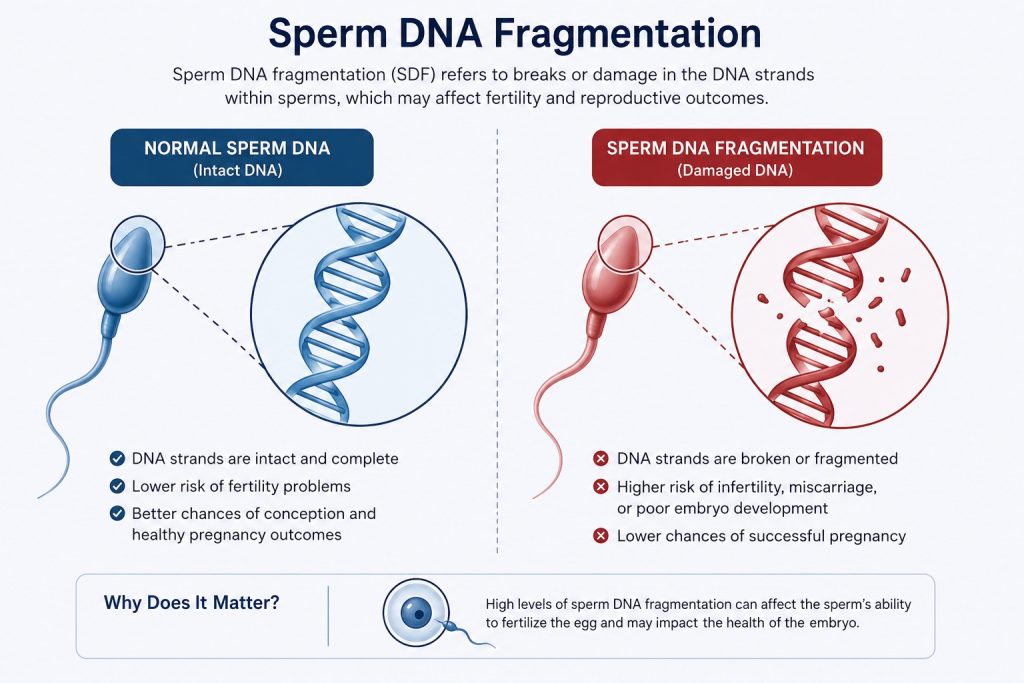
- Sperm DNA fragmentation (SDF): Sperm with fragmented DNA may fertilise an egg but produce embryos that fail to implant, or pregnancies that end in early loss. SDF rates above 15-25% are associated with significantly poorer IVF outcomes, and elevated fragmentation can be present even when count, motility, and morphology look normal.
- Reactive oxygen species (ROS) / oxidative stress: Excess free radicals damage sperm cell membranes and DNA, and are linked to diet, heat exposure, varicocele, infection, smoking, and chronic stress.
- Mitochondrial function: Mitochondria power sperm movement. Subtle dysfunction here may not show up in basic motility scoring but still impairs fertilisation potential.
From a TCM perspective, each of these concerns maps onto identifiable patterns – kidney yang deficiency, damp-heat in the lower jiao, qi and blood stagnation – that acupuncture and herbal medicine are well-suited to address.
What the Research Shows for Male Fertility and TCM
This is where the gap in public fertility content is most stark. While dozens of well-cited articles exist about acupuncture and IVF outcomes for women, the evidence base for male fertility is less often discussed – but it’s substantial.
Acupuncture and sperm quality:
A 2005 prospective controlled study (Pei et al., published in Fertility & Sterility) found that men with idiopathic infertility who received acupuncture twice weekly showed significant improvements in sperm ultrastructure – specifically the integrity of the sperm cell membrane and mitochondrial sheath – compared to controls. These are precisely the structural features that standard semen analysis doesn’t measure.
A 2021 systematic review and meta-analysis (Huang et al., Andrologia) found acupuncture to be associated with improvements in sperm concentration and motility, particularly in men with idiopathic male infertility.
Chinese herbal medicine and sperm parameters:
One of the most-used classical formulas for male fertility in Chinese medicine is Wuzi Yanzong Wan (Five-Seed Progeny Pill) – a formula that has been in continuous use for centuries and has been the subject of multiple modern trials. Studies suggest that this and related formulas may support sperm count, motility, and the antioxidant capacity of seminal plasma.
A meta-analysis referenced in FertilityIQ found that combining Chinese herbal formulas with IVF protocols may improve live birth rates and follicular fluid quality – but this benefit is most pronounced when both partners are receiving care, because sperm quality directly influences embryo quality.
The Sperm DNA Fragmentation Conversation
 If there’s one area where we wish more couples had access to better information, it’s sperm DNA fragmentation (SDF).
Here’s why it matters: an IVF embryology lab can select the most morphologically normal sperm for ICSI. But it cannot visually detect fragmented DNA. A beautiful-looking sperm under a microscope can still carry damaged genetic material that compromises the embryo.
Sperm DNA fragmentation is highly sensitive to:
- Elevated scrotal temperature (tight underwear, laptops on laps, hot baths)
- Oxidative stress from poor diet, smoking, alcohol, or environmental toxins
- Chronic psychological stress – cortisol disrupts testosterone and Leydig cell function
- Varicocele and subclinical infection
Chinese medicine approaches elevated SDF through two primary lenses:
- clearing damp-heat (an internal pattern associated with inflammation and oxidative burden in the lower body) and
- tonifying kidney essence (the constitutional resource that sustains reproductive vitality).
Dietary and lifestyle guidance is almost always part of the conversation.
Importantly, sperm take approximately 74 days to mature (spermatogenesis takes roughly 2.5 months). This means interventions – acupuncture, herbal medicine, dietary change – need to begin at least three months before a planned collection or IVF cycle to allow a full generation of healthier sperm to mature.
This is why we ask couples, wherever possible, to begin care together.
The Emotional Dimension: Why It Matters for Both of You
Fertility treatment places an enormous psychological burden on couples – and research is clear that this burden falls unequally. Women in IVF cycles typically report higher levels of anxiety, depression, and identity stress. Men often report feeling peripheral to the process, less informed, and unsure how to contribute.
This imbalance has a real clinical effect. Chronic psychological stress in men elevates cortisol, suppresses testosterone production, and is directly associated with reduced sperm motility and concentration. Treating the male partner isn’t just good medicine – it gives him a meaningful, active role in the journey. In our experience, this shift – from bystander to participant – has a measurable effect on how couples move through treatment together.
In TCM, the heart and kidney systems are closely connected in reproductive health. Emotional nourishment, sleep quality, and the regulation of the shen (spirit or mind) are not soft extras. They are core clinical variables.
-> Acupuncture for IVF Stress & Anxiety
Our Approach to Couples’ Fertility Care
At Almond Wellness Centre, when a couple comes to us for fertility support, our standard approach is to assess both partners at intake.
For the female partner, we conduct a detailed TCM diagnosis including menstrual history, basal body temperature chart review (if available), tongue and pulse assessment, and a review of any existing investigations.
For the male partner, we review any available semen analysis results and conduct a TCM constitutional assessment – asking about energy levels, sleep, libido, stress, urinary and digestive function, and looking for patterns such as:
- Kidney yang deficiency: Low libido, fatigue, cold extremities, reduced ejaculate volume
- Kidney yin deficiency: Heat signs, restless sleep, reduced semen quality
- Damp-heat in the lower jiao: History of prostatitis, varicocele, urinary infection, or high SDF
- Liver qi stagnation: Chronic stress, irritability, tight shoulders, disturbed sleep
Each pattern informs a distinct treatment strategy.
A Typical Couples’ Treatment Plan
| Partner | Focus | Timeline |
|---|---|---|
| Female | Cycle-phase acupuncture, herbal support, lining and egg quality | 8–12 weeks before transfer |
| Male | Sperm quality optimisation, SDF reduction, lifestyle guidance | 12 weeks before collection |
| Both | Stress regulation, sleep, dietary adjustments | Ongoing through cycle |
We don’t require both partners to attend every session – in practice, the female partner typically comes more frequently. But assessing and supporting the male partner from the outset means the embryos being created have the best possible building blocks from both sides.
What About When Male Factor Is the Primary Diagnosis?
When a semen analysis does show significant abnormalities – very low count, poor motility, high morphology defects – Chinese medicine can still play a valuable role, though it works alongside rather than instead of specialist reproductive medicine input.
In cases of oligospermia or severe oligospermia, we typically recommend:
- A full 3-month acupuncture and herbal programme before repeat semen analysis
- Referral for SDF testing if not already done
- Coordinated care with your IVF specialist, who remains informed of all TCM treatment
Where sperm parameters have improved measurably following TCM treatment, couples have in some cases avoided the need for ICSI, or moved from ICSI to standard IVF fertilisation – a meaningful clinical shift. In other cases, improved sperm quality has contributed to better embryo quality even when ICSI remains the chosen approach.
Frequently Asked Questions
Does the male partner need to come to every appointment?
No. The male partner’s initial consultation takes around 60 minutes, and subsequent follow-up sessions (typically monthly) are shorter. In between, the female partner continues her cycle-phase treatment on the usual weekly schedule.
What if my partner isn’t interested in acupuncture?
That’s common. A significant part of the benefit for male fertility comes from Chinese herbal medicine and dietary/lifestyle guidance, which don’t require regular clinic visits. We can work with whatever level of engagement is comfortable.
Can we start couples’ care mid-IVF cycle?
Yes. The 3-month ideal is exactly that – ideal. We can always start where you are. Even one month of coordinated support is more purposeful than none, and some dietary and lifestyle changes can produce measurable shifts in sperm parameters within 4-6 weeks.
My IVF specialist says semen analysis is normal – why would we treat the male partner?
Normal on semen analysis doesn’t mean optimal. SDF, oxidative stress, and subclinical TCM patterns may be present even when count, motility, and morphology are within reference ranges. Optimisation isn’t the same as normalisation.
Ready to Talk to Us?
Almond Wellness Centre offers fertility consultations at our Coburg clinic and Ringwood clinic. We welcome couples at any stage of their journey – whether you’re just beginning to prepare, trying to conceive naturally, currently in an IVF cycle, or navigating the path after a failed transfer.
Book a couples’ fertility consultation or call us to discuss your situation. We’re here to help both of you.
This article is for general educational purposes and does not constitute medical advice. TCM treatment plans are always individualised. Please consult your fertility specialist and a qualified TCM practitioner before making changes to your fertility care.
References
- Agarwal A, Mulgund A, Hamada A, Chyatte MR. A unique view on male infertility around the globe. Reprod Biol Endocrinol. 2015;13:37. PubMed ID: 25928197
- Pei J, Strehler E, Noss U, et al. Quantitative evaluation of spermatozoa ultrastructure after acupuncture treatment for idiopathic male infertility. Fertil Steril. 2005;84(1):141–7. PubMed ID: 16009170
- Kwon, C.-Y., Lee, B., Lee, S. H., & Jo, J. (2020). Herbal medicine in women undergoing in vitro fertilization/intracytoplasmic sperm injection: A systematic review and meta-analysis. Complementary Therapies in Medicine, 53, 102528.
- Chang, H., Yeung, T. C., Yang, X., Gao, J., Wu, X., & Wang, C. C. (2023). Chinese herbal medicines as complementary therapy to in vitro fertilization-embryo transfer in women with infertility: Protocols and applications. Journal of Obstetrics and Gynaecology, 43(7), 845–863.
- Li, X., Wang, Z., Wang, H., Zheng, Y., Han, X., Chen, W., Wu, H., & Lian, F. (2025). Erzhi Tiangui formula increases the number of high-quality blastocysts in patients with advanced age by regulating the Nrf2/HO-1 signaling pathway: A randomized controlled study. Journal of Ovarian Research, 19, 37.
- Jia, W., Wang, C., & Yin, Y. (2021). Acupuncture for oligospermia and asthenozoospermia: A systematic review and meta-analysis. Medicine, 100(48), e27816.