Author: Dr. Richard Zeng Melbourne acupuncturist, TCM doctor
Quick Navigation
Polycystic ovary syndrome (PCOS) is one of the most common reasons women come to see me at the clinic, whether they’re dealing with irregular periods, absent ovulation, trying to conceive, or managing the metabolic side of PCOS. It’s also a condition I get asked about constantly:
does acupuncture actually do anything for PCOS, or is it just wishful thinking?
A narrative review published this month in the International Journal of Women’s Health (July 2026) took a close look at exactly this question. Rather than cherry-picking studies that support acupuncture, the authors set out to sort the evidence by how direct and reliable it actually is — separating solid human clinical data from promising animal research, and animal research from studies on completely different conditions being used to fill in the gaps. I think that kind of honesty is rare in this space, and it’s worth walking you through what they found.
PCOS is more than an ovary problem
Before getting to acupuncture, it’s worth understanding why PCOS is so stubborn to treat. The review frames it as a whole-system issue – what researchers call a neuroendocrine-immune network problem – rather than something happening in isolation in the ovaries.
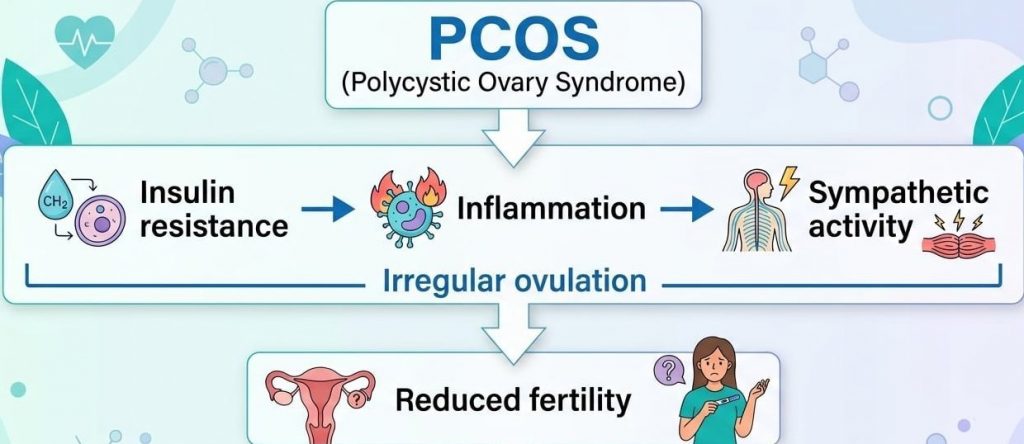
In PCOS, the signalling between the brain and the ovaries (the hypothalamic-pituitary-ovarian axis) tends to run too fast, pushing luteinising hormone (LH) up and leaving follicle-stimulating hormone (FSH) relatively low. That imbalance interferes with follicles developing properly and pushes androgen production up, which then feeds back and speeds the whole cycle up again. Layered on top of that, many women with PCOS also have an overactive sympathetic nervous system (the “fight or flight” side), low-grade chronic inflammation, and insulin resistance – and all three tend to reinforce each other. It’s a genuinely tangled picture, which is part of why no single treatment, acupuncture included, is likely to be a silver bullet.
In TCM terms, this cluster of imbalance and stagnation is often connected to patterns like Phlegm-Damp (痰湿, tán shī) or Kidney deficiency (肾虚, shèn xū) — different language for a similar idea, that the body’s regulatory systems have gotten out of sync.
Here’s a simplified picture of how these pieces feed into one another:
Where the evidence for acupuncture is strongest
The review is refreshingly specific about which effects are backed by solid human trials and which are still hopeful extrapolation from animal studies. Two areas stood out as having the most direct clinical support:
Sympathetic nervous system activity
A randomised controlled trial found that low-frequency electroacupuncture over 16 weeks meaningfully reduced sympathetic nerve activity in women with PCOS, with results comparable to a structured aerobic exercise program. Since sympathetic overactivity is thought to be one of the drivers of PCOS, calming this system down is a genuinely encouraging finding.
Insulin resistance
Several human trials, including a three-arm randomised study comparing acupuncture with metformin, found modest improvements in insulin sensitivity markers (like HOMA-IR) after a course of acupuncture. Given how tightly insulin resistance is linked to androgen excess and ovulatory problems in PCOS, this is a meaningful area of support — though the review is careful to note the effect sizes vary a lot between studies and aren’t as strong or consistent as a first-line medication.
One interesting point from the review is that many of the stronger clinical studies used low-frequency electroacupuncture rather than manual acupuncture alone. Electroacupuncture involves attaching a gentle electrical current to acupuncture needles after insertion, providing consistent stimulation throughout the session. This doesn’t mean manual acupuncture is ineffective, but it does mean the results of these studies may not always translate directly to every acupuncture protocol used in clinical practice – it’s worth asking your practitioner which approach they’re using and why.
Where the picture is more promising than proven
This is the part I appreciate most about the review: it doesn’t pretend the exciting mechanistic story is the same as clinical proof.
A lot of the more detailed explanations you’ll read about how acupuncture might help PCOS – things like rebalancing immune cells in the ovary, correcting the “window of implantation” in the uterine lining, or reprogramming inflammatory pathways at a cellular level – come almost entirely from studies in rats and mice, or from research on completely different conditions like general implantation failure. These are legitimate and interesting research directions, but they’re not the same as evidence that acupuncture does these things in real women with PCOS. The review is explicit that human data confirming these deeper immune mechanisms is largely absent.
On the reproductive outcomes that matter most to patients – actual pregnancy, ongoing pregnancy, and live birth – the evidence is genuinely mixed. One large multicentre trial did not find that acupuncture improved live birth rates when added to standard fertility care. A smaller study on IVF embryo transfer reported better embryo quality and live birth rates, but this hasn’t been consistently reproduced elsewhere, so it should be read as an interesting early signal rather than a proven benefit.
What this means if you’re considering acupuncture for PCOS
When performed by an AHPRA-registered practitioner using sterile, single-use needles, acupuncture is generally considered safe and is commonly used alongside conventional fertility care.
If you’re navigating PCOS, here’s how I’d summarise where things stand:
- Acupuncture is not a substitute for guideline-based PCOS care – lifestyle management, and where appropriate, pharmacological or fertility treatment recommended by your GP, endocrinologist, or fertility specialist.
- There’s reasonably good evidence that acupuncture, particularly electroacupuncture, may help calm an overactive sympathetic nervous system and support insulin sensitivity – two of the underlying drivers of PCOS.
- Evidence for improving menstrual regularity and ovulation remains encouraging but inconsistent across studies, with differences in treatment protocols and study quality making firm conclusions difficult.
- Claims about acupuncture “fixing” implantation or fertility outcomes at a cellular level are not yet supported by strong human evidence, however plausible they may sound.
What I find most useful about this kind of research isn’t a green light or a red light – it’s a map. It tells us acupuncture is a reasonable adjunct worth discussing as part of a broader PCOS management plan, and it tells us where the honest gaps are so nobody’s oversold on what a course of treatment can do.
If you’d like to talk through whether acupuncture could be a useful part of your PCOS management, I’m happy to have that conversation with you at either our Coburg or Ringwood clinic.
FAQ
Can acupuncture cure PCOS?
No. PCOS is a chronic condition with no single cure, and acupuncture is best considered a possible adjunct to lifestyle changes and conventional medical care, not a replacement for them.
Does acupuncture help with PCOS-related weight gain and insulin resistance?
Some clinical trials have shown modest improvements in insulin sensitivity markers with acupuncture, though results vary between studies and individuals.
How long does it take to see results from acupuncture for PCOS?
Studies referenced in the review used courses of treatment lasting around 16 weeks, though individual response varies and should be discussed with your practitioner.
Should I stop my PCOS medication if I start acupuncture?
No – please don’t change or stop any prescribed medication without speaking to your GP or specialist first. Acupuncture is generally considered as an adjunct, not a replacement, for evidence-based PCOS treatment.
Reference
Chen S, Xue Z, Song W. Acupuncture in Polycystic Ovary Syndrome: A Narrative Review of Neuroendocrine–Immune Evidence, Reproductive Outcomes, and Evidence Gaps. Int J Womens Health. 2026;18:614225. https://doi.org/10.2147/IJWH.S614225S614225