Quick Navigation
Here’s a scenario I see often in clinic.
Two women, both 35. One has textbook-regular cycles, falls pregnant without much trouble, and gets told her ovarian health looks great. The other is told her ovarian reserve is declining — sometimes even that she’s at risk of early insufficiency.
Same age. Completely different picture.
If you’ve recently been told your AMH is low, you’re probably asking some version of the following:
- Can ovarian ageing be slowed?
- Does a low AMH mean I can’t get pregnant?
- Is there anything I can do to improve my chances?
The short version: your ovaries don’t run on a fixed clock tied to your birth certificate. Every woman has her own timeline, and the gap between individuals can be as much as 10 to 15 years. Understanding why is the first step to figuring out where you stand – and what you can actually do about it.
Your Ovaries Do More Than Just Store Eggs
It’s easy to think of the ovaries as a kind of storage unit for eggs. In reality, they’re closer to the hormonal command centre of the female body, and they’re doing at least three jobs at once:
- Ovulation – your capacity to conceive naturally
- Hormone production – oestrogen and progesterone, which shape your cycle, mood, sleep, skin, and energy levels
- Whole-body support – ovarian function also feeds into bone density, heart health, metabolism, and even brain function
So when ovarian function starts to slow down, it rarely stays in its lane. You might notice irregular periods, but you might also notice disrupted sleep, mood swings, low energy, or changes in your skin and hair – often well before you’d expect any of that.
Why Two Women the Same Age Can Have Very Different Ovarian Reserve
For a long time, the assumption was that ovarian decline followed a fairly predictable path, winding down somewhere between 45 and 50. The research since has painted a messier – and more interesting – picture.
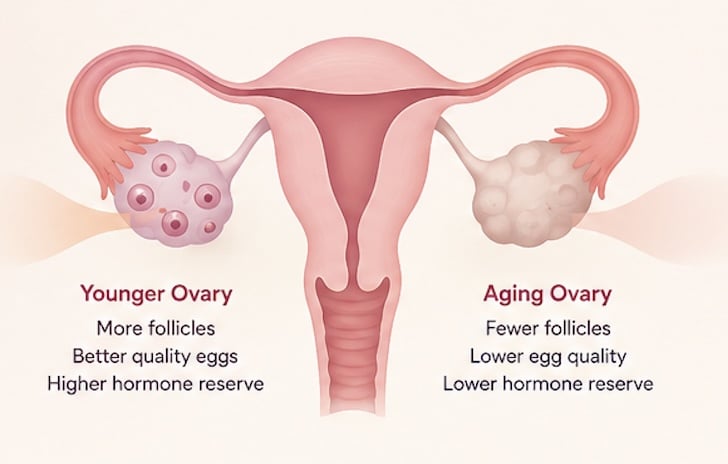
Some women see real decline before 40. Others keep ovulating regularly well into their 50s. And among women who are the exact same age – say, 32 – AMH levels (a key marker of ovarian reserve) can vary fivefold or more from one woman to the next.
AMH, or Anti-Müllerian Hormone, is a blood test commonly used to estimate ovarian reserve. It doesn’t tell us everything about fertility, but it gives a useful snapshot of how many follicles you have remaining.
Your birthday matters, in other words, but it isn’t the whole story. Your ovarian age is what really counts.
Think of It Like an Iceberg
The things we can actually see – irregular cycles, falling AMH, trouble conceiving – are just the tip. Below the waterline, gradual internal changes have usually been building for years before anything shows up on a test or in a symptom.
That’s part of why early awareness matters so much. By the time the markers shift, the underlying process is often already well underway.
A helpful way to think about it: ovarian reserve is a bit like a savings account. You’re born with a fixed number of eggs, and withdrawals happen naturally over time. Everyone starts with a different balance, and everyone’s spending rate is different too.
So, what’s actually driving the differences between women? Four main factors seem to matter most.
1. Genetics: Your Starting Point
Some of this is simply built in from the start.
Certain genes influence how many follicles you’re born with and how quickly your body uses them up. Variants in genes like BMP15 and GDF9, for instance, can affect egg quality and follicle development, while variations in DNA repair genes can speed up follicle loss. A family history of early menopause or primary ovarian insufficiency can also meaningfully raise your own risk.
You may have also heard of telomeres – the protective caps on the ends of your chromosomes, sometimes called the “ageing markers” of your cells. In the ovaries, telomere length tracks closely with egg quality; shorter telomeres tend to go hand in hand with more chromosomal errors and lower IVF success, particularly for women over 38.
That said, genetics is your starting point, not your destiny. The same genetic code can behave quite differently depending on what’s happening around it.
2. Epigenetics: How Lifestyle Shapes Biology
This sounds technical, but the idea is simple: your lifestyle can influence how your genes actually behave, without changing the underlying DNA at all.
Chronic stress, poor sleep, diet, and environmental exposures can all shift your biological age, even while your calendar age stays exactly the same. Research using DNA methylation patterns – essentially a biological “age clock” – has found that women whose ovarian biological age runs ahead of their actual age tend to have lower AMH and fewer eggs retrieved during IVF.
In other words: two 35-year-olds can have genuinely different ovarian biological ages, and how they’ve been living is part of what explains the gap.
3. Mitochondria, Oxidative Stress and Egg Quality
Mitochondria are the power stations inside every cell, and eggs are unusually energy-hungry – so mitochondrial health matters a great deal here.
When mitochondria aren’t functioning well, they churn out excess reactive oxygen species (ROS), which creates oxidative stress – essentially, internal wear and tear. Over time, this can speed up follicle loss, affect egg quality, and raise the odds of chromosomal errors in embryos.
It’s also worth separating egg quantity from egg quality here, because the two get conflated constantly. AMH reflects how many follicles you have left – it doesn’t directly measure how healthy those eggs are. Age remains the strongest predictor of egg quality, though lifestyle and overall health play a real role too.
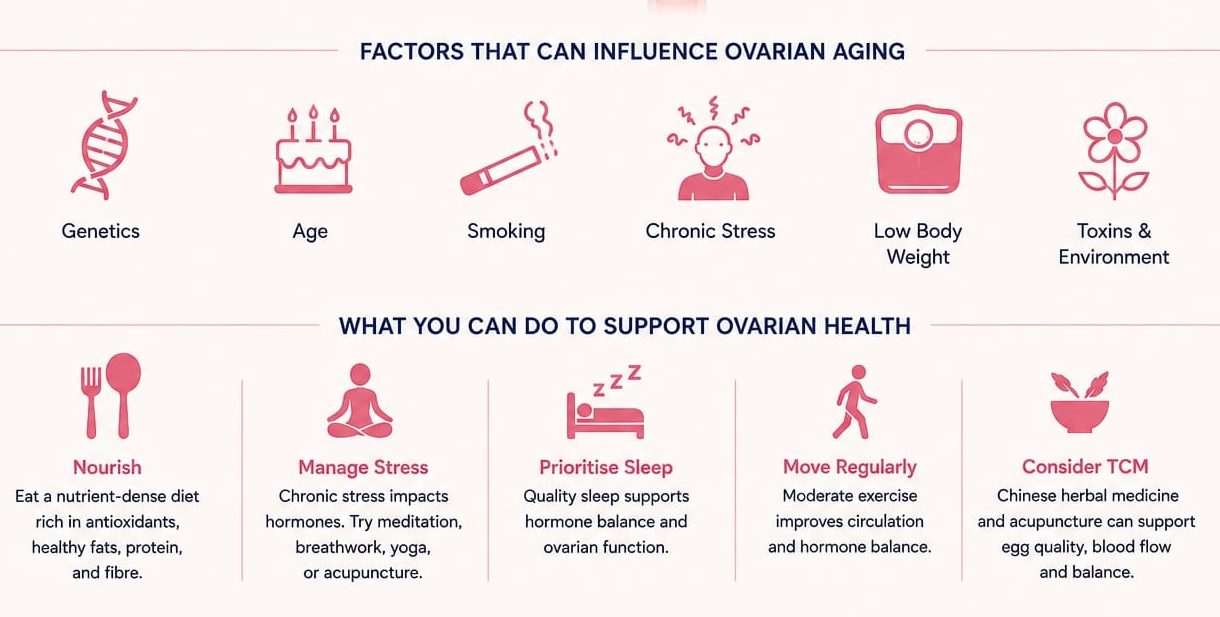
The encouraging part is that this is one area where lifestyle genuinely matters. Good sleep, regular exercise, a balanced diet, stress management, and avoiding smoking all help reduce oxidative stress and support healthier mitochondrial function.
4. Immunity, Environment, and Lifestyle
This category tends to get overlooked, but it matters just as much as the others.
- Smoking damages follicles directly, shortens telomeres, and may bring on menopause one to four years earlier than it would otherwise happen
- Environmental toxins – certain plastics, pesticides, heavy metals – can disrupt hormonal signalling and have been linked to reduced ovarian reserve
- Chronic stress raises cortisol, which suppresses brain-ovary communication and can accelerate follicle loss
- Poor sleep disrupts melatonin, which normally acts as a natural antioxidant in ovarian tissue – so disrupted sleep can compound oxidative stress over time
- Medical factors like certain surgeries, chemotherapy, and radiotherapy can damage ovarian tissue directly, sometimes reversibly and sometimes not
It’s also worth knowing that an estimated 20–30% of premature ovarian insufficiency cases have an autoimmune component, where the immune system mistakenly targets ovarian tissue. It’s more common than most people realise.
What This Means If You’re Preparing for IVF
Women preparing for IVF often ask whether ovarian reserve can be improved. No treatment can create new eggs – that part is fixed. But supporting the health of the follicles you do have, improving general wellbeing, and optimising your body’s environment before treatment may help you get the most out of the eggs that remain.
So, What Can You Actually Do?
You might be thinking: if so much of this comes down to genetics, is it even worth thinking about?
Fair question. And the honest answer is: you can’t change your starting point, but you can influence the direction from here — and the earlier you start, the more options tend to be on the table.
A few practical places to begin:
- Get a baseline. If you’re planning a pregnancy, or just want a clearer picture of your own body, it’s worth knowing your AMH level, cycle regularity, and relevant family history.
- Look after the daily foundations. Prioritise sleep, manage stress where you can, steer clear of smoking, and lean toward whole, unprocessed foods. None of this is glamorous, but the research keeps backing it up.
- Don’t wait for a problem to show up. Many people only look into this after AMH has already dropped. Paying attention earlier – before anything seems “wrong” – is where you tend to have the most options.
- Consider personalised support. In our clinic, acupuncture and Chinese herbal medicine are used alongside conventional fertility care, not instead of it. Treatment is individualised, and may focus on improving menstrual regularity, supporting healthy blood flow to the ovaries and uterus, reducing stress, and preparing the body for natural conception or IVF.
In my years treating women with reduced ovarian reserve – including many preparing for IVF and others hoping to conceive naturally – one of the most common misconceptions I see is that a low AMH result means pregnancy is off the table. Ovarian reserve is an important part of the picture, but it’s only one factor, and every patient’s situation deserves individual assessment.
A Final Thought
Ovarian ageing isn’t something that happens overnight – it’s a gradual process, shaped by genetics, biology, and the small choices you make day to day.
The earlier you understand where you stand, the more tools you have to work with.
In our next article, we’ll look at how to actually assess your ovarian age – what tests are available, what they mean, and how to think about ovarian health at different life stages.
If you’ve recently had blood tests such as AMH or FSH, or you’ve been told your ovarian reserve is low, bringing those results to your consultation can help us better understand your current ovarian health and discuss the most appropriate next steps.
This article is for general information purposes only and does not constitute medical advice. Please consult a qualified healthcare professional for personalised assessment and care.