 Fertility treatment has advanced dramatically over the past two decades. Yet many couples still find themselves asking the same difficult question after failed cycles, disappointing embryo quality, low AMH results, recurrent implantation failure, or unexplained infertility:
“Is there anything else we can do to improve our chances?”
This is where many people begin exploring natural fertility help, especially Chinese herbal medicine (CHM).
At Almond Wellness Centre, we regularly work with patients preparing for IVF, recovering from failed IVF cycles, or trying to conceive naturally after being told their options are limited.
But one important point is often missing from online discussions:
Chinese herbal medicine is not simply about “boosting fertility.”
Its real strength is improving the biological environment needed for conception and implantation.
That distinction matters.
The Problem with Most Fertility Content Online
Most articles about fertility herbs repeat the same generic claims:
- “Improves blood flow”
- “Balances hormones”
- “Reduces stress”
- “Boosts fertility naturally”
The issue is that fertility is rarely caused by one single problem.
- A patient with:
- low ovarian reserve,
- poor embryo quality,
- recurrent miscarriage,
- PCOS,
- endometriosis,
- thin lining,
- immune dysfunction,
- poor sperm DNA integrity,
- or repeated failed implantation
may all be labelled simply as “infertility.”
But biologically, these are very different situations.
This is where Chinese herbal medicine differs from a one-size-fits-all supplement approach.
A More Useful Question: What Part of Fertility Are We Trying to Improve?
Instead of asking:
“Do Chinese herbs improve fertility?”
a better question is:
“Which fertility parameters may Chinese herbal medicine influence?”
Research suggests CHM may affect several important areas involved in conception and IVF outcomes, including:
- ovarian response
- egg quality
- mitochondrial function
- embryo quality
- endometrial receptivity
- uterine blood flow
- inflammation
- oxidative stress
- immune regulation
- luteal phase support
- menstrual cycle quality
- stress physiology and sleep
This systems-based approach is one reason many fertility patients use CHM alongside IVF rather than instead of IVF.
How Chinese Herbal Medicine May Support IVF Outcomes
1. Improving Ovarian Function
One of the most common reasons patients seek herbal support is:
- low AMH
- diminished ovarian reserve (DOR)
- poor ovarian response
- poor egg quality
While herbs cannot “reverse aging,” some studies suggest they may improve the ovarian environment.
A 2025 study involving women with low ovarian reserve found:
- live birth rate was 5% in the control group
- 32% in the CHM-only group
- and 42% in the IVF + CHM group
Women under 37 had particularly better outcomes.
What makes this study interesting is not just the pregnancy rates.
The researchers also created a predictive model using:
- age,
- AMH,
- and treatment type
to estimate live birth probability.
This points toward a future where integrative fertility care may become more personalised and data-driven.
2. Supporting Endometrial Receptivity
Many IVF patients produce embryos but struggle with implantation.
This raises an important clinical question:
Is the embryo the issue – or is the uterine environment not fully receptive?
Research suggests Chinese herbs may help:
- improve endometrial thickness
- regulate uterine blood flow
- reduce inflammation
- support implantation signalling
A randomized controlled trial involving 433 IVF patients found the Chinese herbal group had:
- thicker endometrium,
- higher high-quality embryo rates,
- and improved clinical pregnancy rates compared with controls.
This matters because implantation is not simply mechanical.
A receptive uterine environment requires:
- precise immune balance,
- vascular support,
- hormonal timing,
- and healthy cellular communication.
3. Reducing Oxidative Stress
This is one of the most overlooked topics in fertility care.
Eggs and sperm are highly vulnerable to oxidative stress.
Oxidative stress may affect:
- egg maturation
- embryo development
- sperm DNA integrity
- implantation
- miscarriage risk
Many traditional fertility herbs are rich in:
- flavonoids,
- polysaccharides,
- antioxidants,
- and anti-inflammatory compounds.
For example:
- Gou Qi Zi (Goji berry)
- Dang Gui (Angelica sinensis)
- Tu Si Zi
- Shu Di Huang
are traditionally used to nourish reproductive health and are now increasingly studied for antioxidant effects.
This creates an interesting bridge between traditional Chinese medicine theory and modern reproductive biology.
4. Improving Menstrual Cycle Quality Before IVF
One major gap in mainstream IVF discussions is this:
A menstrual cycle is not just about getting a period.
In TCM, the menstrual cycle provides clinical information about:
- ovulation quality
- luteal function
- circulation
- hormonal timing
- inflammation
- stress physiology
Cycle features such as:
- clotting,
- spotting,
- short luteal phase,
- delayed ovulation,
- painful periods,
- very light flow,
- or premenstrual symptoms
may indicate underlying dysfunction.
Interestingly, several meta-analyses noted that CHM appeared to improve:
- ovulation rates,
- cervical mucus quality,
- basal body temperature patterns,
- and endometrial development.
This is important because IVF outcomes are not determined only during stimulation week.
Often, the months before IVF matter just as much.
Why Timing Matters: The “90-Day Fertility Window”
One of the biggest misconceptions is that herbs work instantly.
In reality, both eggs and sperm develop over approximately 90 days.
This means:
- the quality of sleep,
- stress levels,
- inflammation,
- metabolic health,
- blood flow,
- nutrition,
- and hormonal environment
during the months before IVF may influence outcomes later.
This is why many experienced fertility practitioners recommend starting treatment:
3 – 6 months before IVF
rather than only during the stimulation phase.
This “fertility preparation window” is still under-discussed online despite being clinically important.
Chinese Herbal Medicine Is Usually Individualised
Another reason fertility herb research can be difficult to interpret:
TCM treatment is rarely identical between patients.
Two women with “low AMH” may receive very different herbal formulas depending on:
- menstrual patterns
- sleep
- stress
- digestion
- body temperature
- spotting
- pain
- energy levels
- ovulation patterns
This individualisation is one reason whole-system TCM approaches may produce stronger outcomes than isolated interventions.
A retrospective study involving over 1200 IVF patient records found that:
IVF combined with whole-systems TCM (including herbs, acupuncture, lifestyle and dietary support)
was associated with higher live birth odds compared with IVF alone or acupuncture-only treatment.
That finding is important.
Because in real-world practice, fertility support is rarely “just herbs.”
Common Chinese Herbs Used in Fertility Support
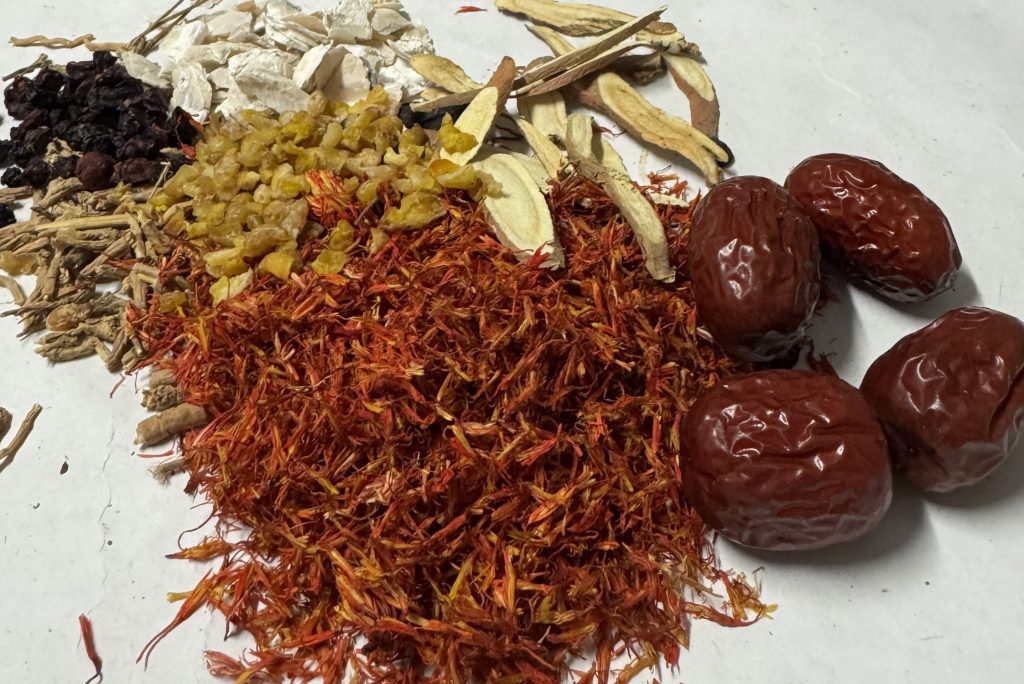
Some commonly used fertility herbs include:
Dang Gui (Angelica sinensis)
Traditionally used to nourish and regulate blood flow.
Shu Di Huang (Rehmannia glutinosa)
Often used to support reproductive and hormonal health.
Tu Si Zi (Semen Cuscutae)
Traditionally used for kidney essence and reproductive function.
Gou Qi Zi (Goji berries)
Rich in antioxidants and commonly used to nourish yin and blood.
Bai Shao (White Peony Root)
Frequently used for menstrual regulation and hormonal balance.
Xiang Fu
Often used when stress, emotional tension, or cycle irregularity are involved.
However, fertility treatment in TCM is usually formula-based rather than relying on single herbs.
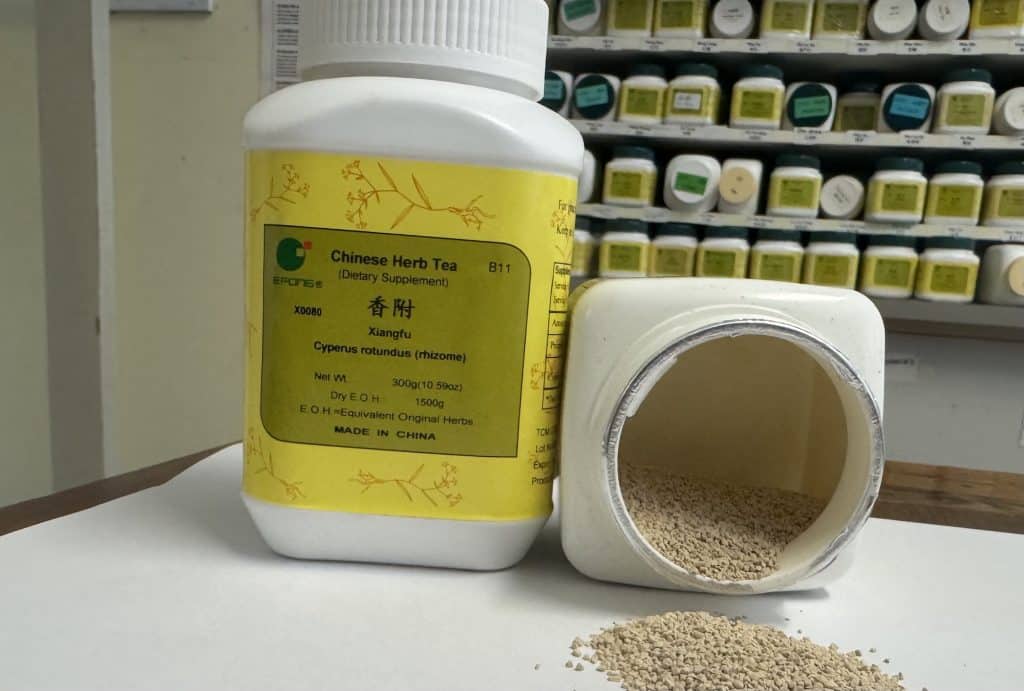
Xiang Fu Herbal Granule
A Better Integrative Fertility Model
One emerging trend in fertility medicine is moving away from isolated treatment models.
Instead of:
- IVF alone,
- supplements alone,
- acupuncture alone,
- or herbs alone,
many clinics are now exploring integrated care models.
The future of fertility care may involve combining:
- reproductive medicine,
- nutrition,
- sleep optimisation,
- stress regulation,
- acupuncture,
- Chinese herbal medicine,
- and lifestyle medicine
into one coordinated strategy.
This is especially relevant for:
- recurrent failed IVF,
- unexplained infertility,
- advanced maternal age,
- low ovarian reserve,
- recurrent miscarriage,
- and complex fertility histories.
Important Safety Considerations
Chinese herbal medicine should always be prescribed by a properly qualified practitioner familiar with fertility and IVF care.
This is particularly important during:
- ovarian stimulation,
- egg collection,
- embryo transfer,
- and early pregnancy.
Herbs may not be appropriate in every phase of IVF treatment.
Coordination between:
- the patient,
- fertility specialist,
- and TCM practitioner
is important for safe and effective care.
Final Thoughts
Chinese herbal medicine is not a miracle cure.
But neither is fertility simply a mechanical process.
Successful conception depends on:
- egg quality,
- sperm quality,
- hormonal coordination,
- implantation biology,
- immune balance,
- circulation,
- inflammation,
- metabolism,
- and emotional wellbeing.
This complexity is exactly why many couples seek a broader and more personalised approach. As our senior acupuncture Chinese medicine practitioner Dr. Richard Zeng says:
The most promising role of Chinese herbal medicine is not to “replacing IVF”
It is to create a healthier biological environment in which IVF (or natural conception) has a better chance of succeeding.
Research References
- Hullender Rubin LE, Opsahl MS, Wiemer K, Mist SD, Caughey AB. Impact of Whole Systems Traditional Chinese Medicine on In Vitro Fertilization Outcomes. Reproductive Biomedicine Online. 2015;30(6):602–612. doi:10.1016/j.rbmo.2015.02.005
- Chang H, Yeung TC, Yang X, Gao J, Wu X, Wang CC. Chinese Herbal Medicines as Complementary Therapy to In Vitro Fertilization-Embryo Transfer in Women with Infertility: Protocols and Applications. Journal of Obstetrics and Gynaecology. 2024;44(1):2266619. doi:10.1080/14647273.2023.2266619
- Ried K, Stuart K. Efficacy of Traditional Chinese Herbal Medicine in the Management of Female Infertility: A Systematic Review. Complementary Therapies in Medicine. 2011;19(6):319–331. doi:10.1016/j.ctim.2011.09.003
- Ried K. Chinese Herbal Medicine for Female Infertility: An Updated Meta-analysis. Complementary Therapies in Medicine. 2015;23(1):116–128. doi:10.1016/j.ctim.2014.12.004
- Wu MH, Wang SC, Su PF, Tsai LM, Chen PM, Li CJ, et al. Effect of Chinese Herbal Medicine on Pregnancy Outcomes in IVF Patients with Low Ovarian Reserve: A Predictive Model. Medicina (Kaunas). 2025;61(9):1571. doi:10.3390/medicina61091571
- Guo J, Li D, Liu C, Ji X, Li R, Du X. Effects of Chinese Herbs Combined with In Vitro Fertilization and Embryo Transplantation on Infertility: A Clinical Randomized Controlled Trial. Journal of Traditional Chinese Medicine. 2014;34(3):267–273. doi:10.1016/S0254-6272(14)60089-3