Seeing a high FSH (Follicle-Stimulating Hormone) level on your fertility test results can feel discouraging and deeply concerning. In Western medicine, it’s often interpreted as a sign of diminished ovarian reserve, suggesting that your ovaries need more stimulation to produce a follicle.
Quick Navigation
If you’ve received this diagnosis, you might be wondering if there’s still hope. We want you to know this: a high FSH level is not the end of your fertility journey. From the perspective of Traditional Chinese Medicine (TCM), it’s a clear message from your body asking for deeper nourishment and balance. And this is exactly where acupuncture and Chinese medicine can offer a powerful, holistic path forward.
How Chinese Medicine Views Elevated FSH: The Fertility Tank Analogy
In TCM, reproductive health is rooted in the Kidney system, which governs growth, development, and fertility. The core of this system is Kidney Jing (Essence) – which you can think of as your body’s innate “Fertility Tank“.
 Understanding Your Fertility Tank (Kidney Jing)
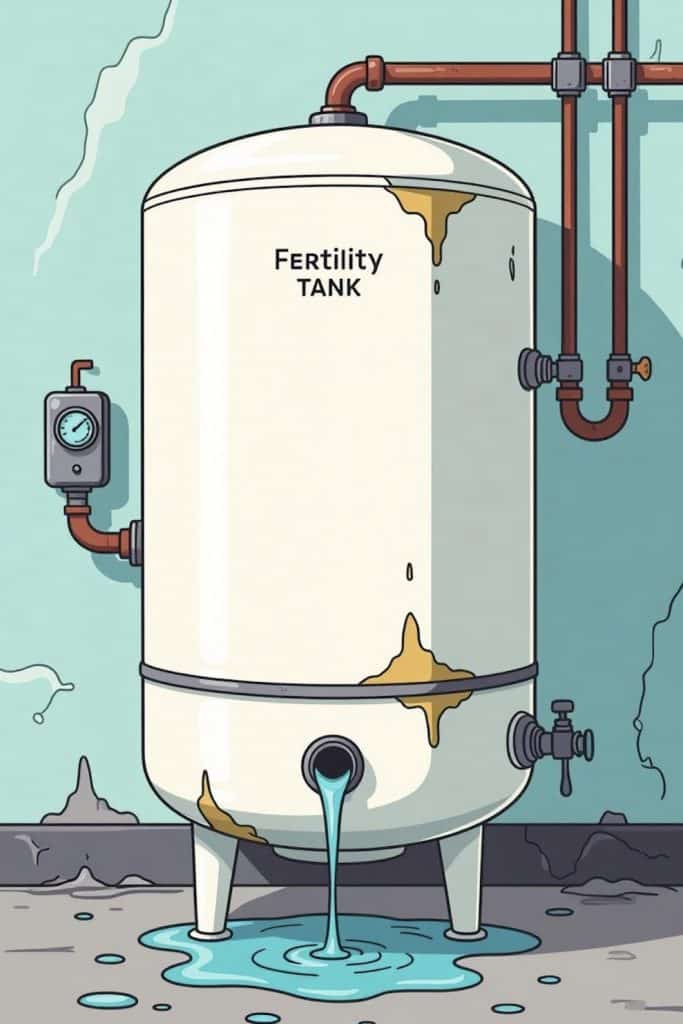 Understanding Your Fertility Tank (Kidney Jing)
Jing is Your Pre-Battery: You are born with a certain amount of this essential energy, and it naturally, gradually depletes with age.
It Fuels Reproduction: Jing is the deep reserve that powers your menstrual cycles, ovulation, and healthy egg development.
It Can Be Depleted Faster: Chronic stress, overwork, poor sleep, and illness can all cause your body to draw down this tank more quickly.
A high FSH result, in TCM terms, is often a sign that this “Fertility Tank” is running low. Your body is having to shout louder (with high FSH) to get a response from the ovaries.
The Role of Kidney Yin: The Cooling, Nourishing Fluid
In TCM, high FSH is frequently linked to Kidney Yin Deficiency. If Jing is the fuel in the tank, Yin as the cooling, nourishing, moistening aspect of the Jing. It ensures everything runs smoothly without overheating.
When Kidney Yin is deficient, the body can’t cool itself properly, leading to a type of internal “empty heat.” This heat can further disrupt hormonal balance and contribute to that high FSH reading.
Do you recognise these signs of a low “Tank” or Yin deficiency?
- Night sweats or/and hot flushes
- Dry skin, hair, or eyes
- Scant or absent periods
- Insomnia, feeling “wired but tired”
- Lower back ache
- Anxiety
A Whole-Body Perspective: It’s Not Just the Kidneys
While the Kidney system is the foundation, true balance involves the whole body. High FSH often involves other key systems:
The Liver: The Liver ensures smooth flow of energy and blood. **Liver Qi Stagnation**—often from stress and frustration—can lead to irregular cycles, PMS, and feeling tense or irritable.
The Spleen: The Spleen is our energy and blood producer from food. A weak Spleen means not enough nourishment is being made to support the Uterus and a potential pregnancy.
The Heart: The Heart houses our spirit (Shen). When we feel anxious or have poor sleep, it can disrupt the vital connection between the Heart and the Uterus, affecting emotional well-being and implantation.
Our Treatment Approach: Refilling Your Fertility Tank
The goal of treatment is simple but profound: to nourish the Kidneys, replenish Jing and Yin, and bring your entire body back into harmony. We aim to create a more receptive and nourishing environment for your fertility.
Acupuncture: Regulating and Restoring Balance
Acupuncture is a powerful tool for regulating the hormonal axis (HPO axis), increasing blood flow to the ovaries and uterus, and profoundly reducing stress. Treatments are relaxing and tailored to your unique needs.
Commonly used points include:
SP6 (Sanyinjiao): A powerhouse point that nourishes the Liver, Spleen, and Kidney Yin all at once.
KD3 (Taixi): A major point to strengthen and tonify the Kidney system.
RN4 (Guanyuan): Located on the lower abdomen, this point directly warms and nourishes the Uterus and essence.
HT7 (Shenmen): Calms the mind and spirit, eases anxiety, and promotes restful sleep.
Chinese Herbal Medicine: Deep, Internal Nourishment
Herbs provide the foundational building blocks that acupuncture directs. Your practitioner will create a custom formula for you, but for a depleted “Fertility Tank” (Kidney Yin/Jing deficiency), a classic base formula is **Zuo Gui Wan** (Left-Restoring Pill).
Key herbs and their roles:
Shu Di Huang (Rehmannia): The “emperor” herb that deeply nourishes Blood and Kidney Essence—it’s like putting high-quality fuel in your tank.
Shan Yao (Chinese Yam): Supports the Spleen and Kidneys, helping your body better absorb the nourishment.
Gou Qi Zi (Goji Berry): Nourishes Liver and Kidney Yin, supporting overall vitality.
Tu Si Zi (Cuscuta Seed): Helps to stabilise and consolidate your Jing.
If there are signs of “empty heat” like night sweats, we add cooling herbs like Zhi Mu or Di Gu Pi to restore a calm, cool balance.
Case Examples
Case 1:
“Sarah,” 34, came to us with an FSH level of 18.5 mIU/mL and an AMH of 0.4 ng/mL. She had been told her chances to conceive with her own eggs were very low. She also experienced night sweats, poor sleep, and felt constantly anxious.
Her TCM diagnosis was a severely depleted Kidney Jing with Kidney Yin Deficiency and Liver Qi Stagnation.
We designed a plan with weekly acupuncture and a personalised herbal formula based on Gui Shao Di Huang Wan (归芍地黄丸). After two months, her night sweats had resolved, her sleep and mood improved significantly, and her period became more regular and the flow were more substantial. Most importantly, a repeat test showed her FSH had dropped to 9 mIU/mL. This shift created a more favourable environment, and she was able to produce a viable embryo for her next IVF cycle.
Case 2:
“Emma”, 41. Emma experienced perimenopausal symptoms including hot flashes, anxiety, and insomnia. Her FSH level was 25 IU/L, indicating diminished ovarian reserve. From a Traditional Chinese Medicine (TCM) perspective, her pattern was diagnosed as Kidney Yin Deficiency with Heart Fire — a common presentation in women with high FSH levels.
Her treatment plan included acupuncture and a modified Liu Wei Di Huang Wan herbal formula to nourish Yin, calm the mind, and restore hormonal balance. After two months, her symptoms eased significantly — her FSH dropped to 11 IU/L, her menstrual cycle resumed, and she reported better sleep and energy.
“Acupuncture and Chinese medicine gave me hope when my hormones felt out of control,” Emma shared.
(Please note: These are an individual cases and results may vary.)
 What Does the Research Say?
 What Does the Research Say?
While individual results may vary, a growing body of research has explored how Chinese medicine may support hormone regulation and fertility.
You’re right to ask for proof—TCM isn’t just tradition; it’s backed by growing research. A 2023 meta-analysis found acupuncture significantly lowers FSH, improves AMH (anti-Müllerian hormone), and boosts ovarian function in women with diminished reserve. Another 2024 study showed acupuncture reduces FSH while increasing estrogen, alleviating perimenopause symptoms. pmc.ncbi.nlm.nih.gov, frontiersin.org
For herbs, a review on Chinese formulas like those tonifying Kidney Yin demonstrated improved fertility outcomes and hormone balance in POI (premature ovarian insufficiency). A 2025 review in the Journal of Ovarian Research found that Chinese herbal medicine may help improve ovarian function and regulate hormones in women with diminished ovarian reserve (DOR). The review of clinical and basic studies showed CHM supports the hypothalamic–pituitary–ovarian axis, reduces oxidative stress, and protects ovarian cells — suggesting potential benefits for women with high FSH and reduced fertility (Zhang et al., J Ovarian Res, 2025; 18:90) . sciencedirect.com
While more large-scale studies are needed, these findings are promising and align with my clinical experience.
Fill Your Fertility Tank at Almond Wellness Centre
A high FSH level can feel like a setback, but it’s not a final verdict. It’s your body’s way of asking for deeper, more foundational care.
At Almond Wellness Centre we specialise in listening to these messages. We combine the wisdom of Chinese medicine with a compassionate, personal approach to help you refill your “Fertility Tank”, balance your energy, and nurture your vitality and hope.
You don’t have to walk this path alone. If you’re ready to explore a supportive holistic approach to your fertility, or prepare and support your IVF treatment, you can book online or call 8802 1519 to speak to our friendly receptionist team.
Disclaimer: Individual responses to Chinese medicine treatment may vary. Consultation with a qualified TCM practitioner is recommended to determine the most suitable herbs, formulations and acupuncture treatment based on individual health conditions. This information is for educational purposes and does not replace professional medical advice.
References
Click to View References
Zhao, L. Q. (2009). TCM Treatment of Female Infertility Caused by High FSH. Journal of the Association of Traditional Chinese Medicine (UK), 16(1), 13–17.
Xu, J. Y., et al. (2022). Acupuncture for Female Infertility: Discussion on Action Mechanism and Application. Evidence-Based Complementary and Alternative Medicine, 2022, 3854117.
Chen, C.-H., et al. (2011). Liu Wei Di Huang Wan, a well-known traditional Chinese medicine induces CYP1A2 while suppressing CYP2A6 and N-acetyltransferase 2 activities in man. Journal of Ethnopharmacology, 133(2), 613–619.
Lin, G., et al. (2023). Clinical efficacy of acupuncture for diminished ovarian reserve: a systematic review and meta-analysis of randomized controlled trials. Frontiers in Endocrinology, 14, 1136121.
Cao, H., et al. (2024). The clinical value of acupuncture for women with premature ovarian insufficiency: a systematic review and meta-analysis of randomized controlled trials. Frontiers in Endocrinology, 15, 1361573.
Shao, Y., et al. (2020). Chinese herbal medicine for premature ovarian insufficiency: A protocol for systematic review. Medicine, 99(11), e19371.
Li, H.-f., et al. (2023). Dissecting the efficacy of the use of acupuncture and Chinese herbal medicine for the treatment of premature ovarian insufficiency (POI): A systematic review and meta-analysis. Heliyon, 9(10), e20498.
Ushiroyama, T., et al. (2004). A pilot study of a Kampo formula, EH0202, with intriguing results for menopausal symptoms. Journal of Alternative and Complementary Medicine, 10(2), 397–399.
Daghighi, S. (2011). Effectiveness of Acupuncture and Chinese Medicine Herbs in Lowering FSH Level of a Thirty-Nine Year Old Female: A Case Study. Yo San University Capstone Project.
Elliott, D. (2009). The Treatment of Elevated FSH Levels with Chinese Medicine. Journal of Chinese Medicine, 91, 5–11.
More to Read
Click to Read More
- Acupuncture and Chinese Medicine for Primary Ovarian Insufficiency (POI) in Melbourne: A Case Report
- Women’s 7 Year Life Cycle
- Menstrual Cycle and Traditional Chinese Medicine
- Can You Have a Period Without Ovulating?
- Having Two Periods in One Month? You May Just Have Ovulation Bleeding 一个月来两次月经?你也许只是排卵期出血
- Amenorrhea, Fertility and Chinese Medicine
- Menopause Acupuncture Melbourne
- Beyond Age: My Insights on the Real Factors Affecting Your Egg Quality