
Author: Dr. Richard Zeng Acupuncturist Melbourne, Doctor of Chinese Medicine
Quick Navigation

If you’ve recently had an AMH blood test and found yourself staring at a number with no idea what to make of it, you’re not alone.
Every week in my clinic, I see women holding a pathology report with an AMH result that has set off a wave of anxiety – often without much explanation from whoever ordered the test. The number sits there looking definitive. It rarely comes with context.
So let me give you that context.
What is AMH?
AMH stands for Anti-Müllerian Hormone. It’s produced by small follicles in your ovaries – the tiny fluid-filled sacs that each contain an immature egg. The more follicles you have actively developing at any given time, the higher your AMH level will be.
In simple terms: AMH is a marker of your ovarian reserve – the pool of eggs remaining in your ovaries.
Unlike other fertility hormones such as FSH or oestradiol, AMH levels stay relatively stable across your menstrual cycle. You can have the test done on any day without timing it to a particular cycle phase. That consistency is one of the reasons it has become a widely used fertility screening tool.
AMH levels by age: a reference guide
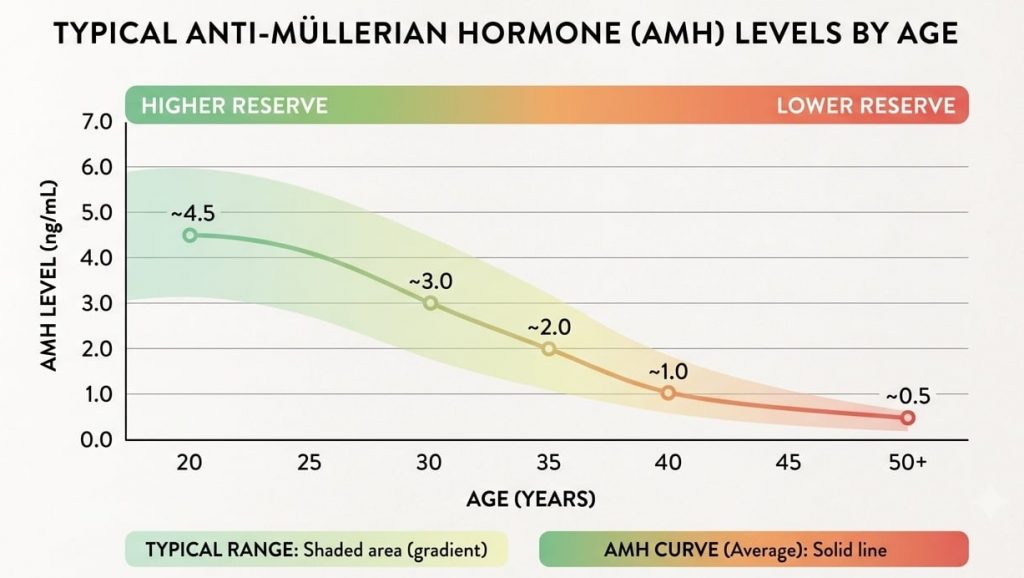
AMH naturally declines with age. This is completely expected – it’s how reproductive biology works. The question isn’t just what your number is, but what it means for your age.
Most Australian pathology reports list AMH in either ng/mL (nanograms per millilitre) or pmol/L (picomoles per litre). If you need to convert between the two: 1 ng/mL ≈ 7.14 pmol/L.
Approximate age-adjusted AMH reference ranges:
| Age | ng/mL | pmol/L |
|---|---|---|
| Under 30 | 2.0 – 6.8 | 14 – 49 |
| 30–34 | 1.2 – 5.8 | 9 – 41 |
| 35–37 | 0.7 – 3.5 | 5 – 25 |
| 38–40 | 0.3 – 2.8 | 2 – 20 |
| 41–43 | 0.1 – 2.5 | 1 – 18 |
| Over 43 | 0.1 – 1.5 | 1 – 11 |
These are approximate reference ranges. Specific values differ between laboratory assays and should always be interpreted by your doctor alongside your full clinical picture.
A result below the expected range for your age may prompt your doctor to describe it as “low AMH” or “diminished ovarian reserve.” A result above the upper range may indicate a high follicle count, which can be associated with PCOS, and has its own clinical considerations.
What low AMH actually tells you
Low AMH tells you one specific thing: that your measurable pool of developing follicles is smaller than expected for your age.
What it doesn’t tell you is anything definitive about:
Egg quality. AMH reflects quantity, not quality. You can have low AMH and excellent egg quality. You can have high AMH and poor quality. The two don’t map neatly onto each other.
Your ability to conceive. Many women with low AMH conceive naturally or through IVF. A low number makes the path more complex – it doesn’t close the door.
How long you’ve been this way. AMH is a snapshot taken at one moment in time. There’s no way to know from a single reading whether your levels have been declining rapidly or have been stable for years.
Why your reserve is low. Low AMH has many possible causes – autoimmune conditions, previous ovarian surgery, endometriosis, genetics, or simply a naturally smaller starting reserve. These distinctions matter for how you approach the situation.
I say this not to offer false reassurance, but because a number out of context causes a particular kind of distress. The full picture is almost always more nuanced than a single result conveys.
What the AMH test doesn’t measure
This is something I feel strongly about explaining, because I think it gets glossed over.
AMH is a useful screening marker. It is not a complete fertility assessment.
It doesn’t measure:
- Whether you’re ovulating
- The quality of your endometrial lining
- Whether your fallopian tubes are open
- Your partner’s sperm health
- The hormonal environment your eggs are maturing in
Fertility involves many variables. AMH is one. It’s worth knowing – but it’s rarely the only thing that matters.
The Chinese medicine perspective on ovarian reserve
In Traditional Chinese Medicine, we don’t have a direct equivalent to AMH – it wasn’t part of the classical framework. But there is a concept that maps closely to what AMH is measuring: Kidney Jing (精).
Kidney Jing is the inherited constitutional essence that supports reproductive vitality. It is finite, and it naturally declines over time – much as AMH does. But it can be nourished, supported, and protected through acupuncture, herbal medicine, and lifestyle.
When I assess a patient with low AMH, I’m not looking at the number in isolation. I’m looking at:
- Which underlying pattern is present – Kidney Yang deficiency, Kidney Yin deficiency, Blood deficiency, Liver Qi stagnation, or a combination
- How the menstrual cycle looks as a whole – regularity, flow, colour, consistency
- Energy levels, sleep, temperature regulation, and other signs of overall vitality
Treatment aims to support ovarian environment, improve circulation to the reproductive organs, and regulate the hormonal conditions in which eggs mature.
→ Learn more about Kidney Jing – the Fertility Essence in TCM and How to Refill Your Fertility Tank.
I want to be clear about what this means clinically: we are not claiming that acupuncture or herbal medicine can directly raise an AMH number. What we work toward is improving the broader physiological environment – circulation, hormonal regulation, and systemic resilience – in a way that may support reproductive health and IVF outcomes.
→ Learn more about our approach to low AMH here
What to do after a low AMH result
Here are the practical steps I would suggest:
1. Get a full hormonal picture
A single AMH result tells an incomplete story. Ask your GP or fertility specialist to also test FSH, LH, oestradiol, and antral follicle count (AFC) via ultrasound. Together, these give a far clearer view of where things stand.
2. Understand your timeline
If you’re not actively trying to conceive right now, knowing your AMH level allows you to plan. If you are trying, it can help you and your fertility specialist decide on the right approach – timed natural conception, ovarian stimulation, or IVF.
3. Consider the 90-day window
Egg development takes approximately 90-120 days from early follicle recruitment to ovulation. This is the window in which supportive treatment – whether acupuncture, herbal medicine, or lifestyle change – may have the most potential influence. Starting early matters more than starting perfectly.
Learn more about 3-4 Month Preconception Window and IVF Acupuncture Melbourne
4. Address what’s within your control
Smoking, alcohol, a highly inflammatory diet, chronic sleep disruption, and unmanaged stress all affect the environment your eggs are maturing in. These factors won’t override genetics, but they are modifiable – and they matter.
Frequently asked questions
Can AMH levels improve?
AMH levels are significantly influenced by genetics and generally decline with age.
Some research suggests that certain lifestyle interventions and treatment protocols may be associated with modest improvements in antral follicle count and related hormonal markers – though this is an active area of research and we are careful not to make definitive claims about directly raising AMH.
What we do see, clinically, is that many patients who support their overall reproductive health report improvements in how they feel and, in some cases, in related markers over time.
What is considered a critically low AMH level?
Results below approximately 0.5 ng/mL (3.5 pmol/L) are often described as severely diminished ovarian reserve.
Results below 0.16 ng/mL (1.0 pmol/L) may be considered very low or near-undetectable. At these levels, a fertility specialist will typically recommend discussing IVF relatively soon, given the potential for continued natural decline.
Some women in this range may also meet criteria for premature ovarian insufficiency (POI), which warrants its own investigation.
Can you get pregnant naturally with low AMH?
Yes.
AMH reflects the quantity of developing follicles, not the presence or absence of ovulation. Women with low AMH may still ovulate regularly and conceive naturally. The primary concern is the reduced time margin – a smaller reserve means less room for delay – and the potential for a lower IVF response if assisted conception becomes necessary.
Is AMH the same as ovarian reserve?
AMH is one marker of ovarian reserve, not the whole picture.
Antral follicle count (AFC) on ultrasound and FSH are also used. No single marker fully captures ovarian reserve, which is why clinicians typically interpret these together rather than acting on any one result alone.
How often should I retest?
There is no universal guideline.
If you have had a low or borderline result, retesting after 6 – 12 months can help assess rate of change. Results can also vary between laboratory assays, so if your result seems unexpected, retesting at the same lab provides a more useful comparison.
Supporting your fertility at Almond Wellness Centre
Whether you’re just beginning to investigate your fertility or you’re in the middle of an IVF cycle, understanding what your results actually mean is the starting point.
Our approach combines the depth of classical Chinese medicine with a careful understanding of where Western diagnostics like AMH sit in the broader picture. If you’d like to discuss your results and explore what a personalised treatment approach might look like, we’d be glad to help.
Dr. Richard Zeng is a fourth-generation TCM practitioner with over 30 years of clinical experience in fertility and women’s health. Almond Wellness Centre has clinics in Coburg and Ringwood, Melbourne.