A practical, honest guide
Author: Dr. Richard Zeng (Acupuncturist Melbourne, TCM Doctor)
Quick Navigation
“Doctor… I know time is not really on my side.”
She said it quietly.
She was 41.
They’d been trying for over a year.
A fertility specialist had already told her her AMH was low and her egg quality “not ideal.”
She paused for a moment, then asked the question I hear from so many women sitting in that same chair.
“I just want to know… is there anything else I can still do?”
For many of my patients, that question is the beginning of a very different journey, and if you’re reading this, you might be in a similar place.
By this point, many women already understand the numbers. AMH, follicle count, hormone levels. They’ve already spent months researching before they even walk into my clinic.
What you’re looking for is a shift away from looking at fertility as just numbers on a lab report, and toward understanding the whole body, the whole person.
That’s where Traditional Chinese Medicine (TCM) – especially Chinese herbal medicine – often comes in.
Let’s talk about it properly. No false promises. No empty hope. Just an honest conversation about what may still help.
First – How TCM Sees Fertility Over 40
In Western medicine, the focus is very clear:
- ovarian reserve
- egg quality
- hormone levels
These are all important when it comes to fertility.
But in TCM, my goal is to zoom out and ask about your body overall.
- How regular is your cycle?
- How is your sleep?
- Your digestion?
- Your stress levels – really?
Because from a TCM perspective, fertility isn’t just about the ovaries. It’s about the environment your body creates every month.
It’s important to note that two women, both 40, same AMH – may receive completely different herbal formulas. Because in TCM, we don’t treat “being 40.”
We treat you.
So… What Do Chinese Herbs Actually Do?
This is where expectations matter.
Chinese herbs don’t “boost egg quality overnight.” They don’t override biology. What they can do is support:
- hormonal balance
- blood flow to the uterus
- stress response
- overall reproductive environment
In the clinic, I often explain it this way:
“We are not changing the egg itself – we are improving the soil it grows in.”
The 5 Most Common Herbal Patterns We See
These are the patterns we actually see in clinic.
1. Kidney Yin Deficiency
(Often linked to the “running low” feeling)
This is one of the most common patterns in women over 40.
You might notice:
- shorter cycles
- light periods
- night warmth or mild night sweats
- dryness
- that “afternoon crash”
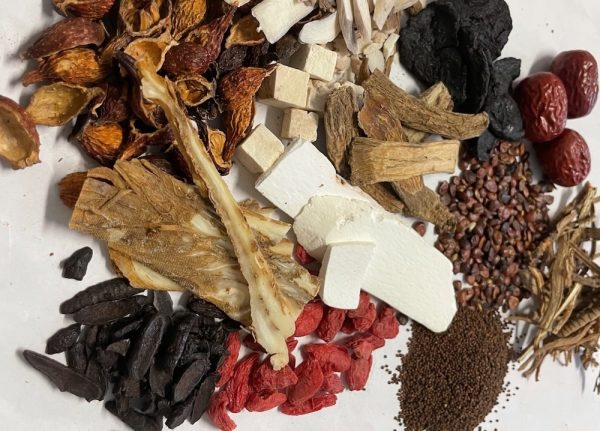
Common herbs:
- Shu Di Huang
- Bai Shao
- Gou Qi Zi (goji)
- Shan Zhu Yu
- Nü Zhen Zi
These formulas aim to nourish and rebuild.
2. Kidney Yang Deficiency
(When things feel… cold, slow, low energy)
Different pattern, different feeling.
You may have:
- feeling cold (especially lower back/abdomen)
- long cycles
- low libido
- fatigue, especially mornings
Common herbs:
- Yin Yang Huo
- Xian Mao
- Ba Ji Tian
- Tu Si Zi
- Du Zhong
Balanced support. Not extreme.
3. Blood Deficiency
(Not enough nourishment for the uterine lining)
You might see:
- light periods
- dizziness
- poor sleep
- anxiety or palpitations
Common herbs:
- Dang Gui
- Bai Shao
- Shu Di Huang
- Long Yan Rou
I have a patient who once told me:
“I didn’t realise how tired my body was… until I started feeling stronger again.”
That’s the result of blood tonics and medicinal herbs working quietly in the background.
4. Qi Deficiency
(Energy is the foundation of your body and it is often overlooked)
Very common. Especially in busy women juggling work, family, IVF appointments…
Signs:
- constant fatigue
- bloating
- loose stools
- feeling overwhelmed easily
Common herbs:
- Huang Qi
- Dang Shen
- Shan Yao
- Bai Zhu
These are not glamorous herbs. But they are essential. Without good digestion and energy, nothing else works properly.
5. Blood Stagnation
(When things are stuck rather than lacking)
This one is different.
Signs:
- painful periods
- clots
- fixed pain
- endometriosis (in TCM context)
Common herbs:
- Chuan Xiong
- Chi Shao
- Yi Mu Cao
- Tao Ren
Used carefully, especially if you’re actively trying to conceive.
A Real Case I Had (You Might Relate)
A patient, 42, came in after 2 failed IVF cycles.
Her words:
“They told me my egg quality is poor. I feel like I’m running out of time.”
We worked together for about 3 months in regular appointments:
- herbs + acupuncture
- focus on sleep, digestion, stress
After that:
- her cycle became more regular
- her energy improved
- she felt “more stable” emotionally
She went on to do another IVF cycle.
Was it a guarantee? No.
But she said something that stayed with me:
“At least now I feel like my body is working with me, not against me.”
How Long Does It Take?
This is one of the most common questions I am asked.
Realistically:
- 4–6 weeks → you may start noticing changes
- 8–12 weeks → clearer pattern shifts
In our clinic:
about 50–60% of patients report noticeable improvement within 2–3 cycles
Improvement might mean:
- better cycle regularity
- improved energy
- less PMS
- better sleep
It is not a dramatic overnight change, but shows consistent signs of steady, meaningful progress.
Self-Prescribing Herbs Is Not a Good Idea, Why?
This part is important.
Chinese herbal medicine is not like buying supplements online. The same herb can help one person or worsen symptoms in another.
It depends on:
- your pattern
- dosage
- combination
- timing within your cycle
Also:
- herbs may interact with IVF medications
- quality varies significantly
So yes, while I understand the temptation to “just try something”, in practise it often leads to wasted time or worse – imbalance.
Working With a TCM Practitioner
At Almond Wellness Centre, we approach this step by step.
Your first consultation includes:
- full fertility history
- cycle assessment
- sleep, digestion, stress
- IVF plans (if relevant)
Then we decide:
- herbs
- acupuncture
- or both
And we adjust as your body changes.
A Gentle, Honest Note
Chinese herbal medicine has been used for thousands of years. Modern research is still evolving.
What we can say is:
- it can support your body
- it can improve your internal environment
- it can complement medical treatment
But:
- it is not a guarantee
- it is not a replacement for IVF or medical care
From our experience in treating patients, the best results usually come from combining both approaches.
If You’re Over 40 and Trying to Conceive…
You’re not alone.
And you’re not “too late”, although yes, time matters.
So the goal is:
use the time you have as effectively as possible
If you’re exploring Chinese herbal medicine, the most helpful step is a personalised plan.
Ready to Talk?
We have clinics in Melbourne:
In our Melbourne clinics, many women come to us for fertility acupuncture and Chinese herbal medicine after being told their AMH is low or their egg quality may be declining with age.
Coburg – 21 Bell Street
Ringwood – 31 Wantirna Road
📞 03 8802 1519
Book OnlineRelated Reading
Chinese Medicine for Fertility